Where Do High-Net-Worth Families Prefer to Go? New 2026 Report Reveals
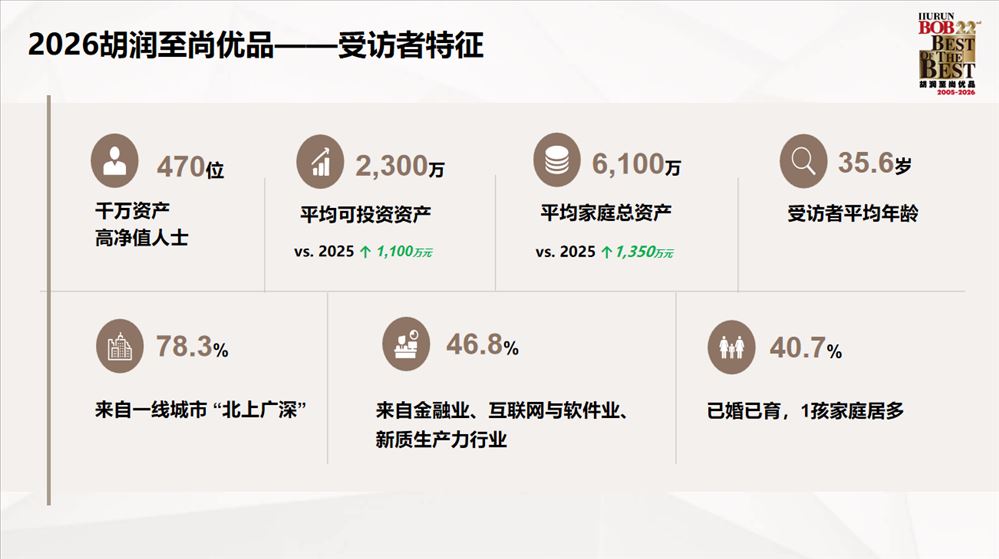
Recently, Hurun Research Institute released the "2026 China High-Net-Worth Individuals Quality of Life Report." The survey covers 470 high-net-worth individuals, with an average total family asset of 61 million yuan. The report shows that high-net-worth families are increasingly focusing their judgments on studying abroad, identity, and overseas investments, with the United States remaining one of the most favored destinations.
Children's Study Abroad Choices Are Becoming More Concentrated
The United States Continues to Be a Stable Attraction
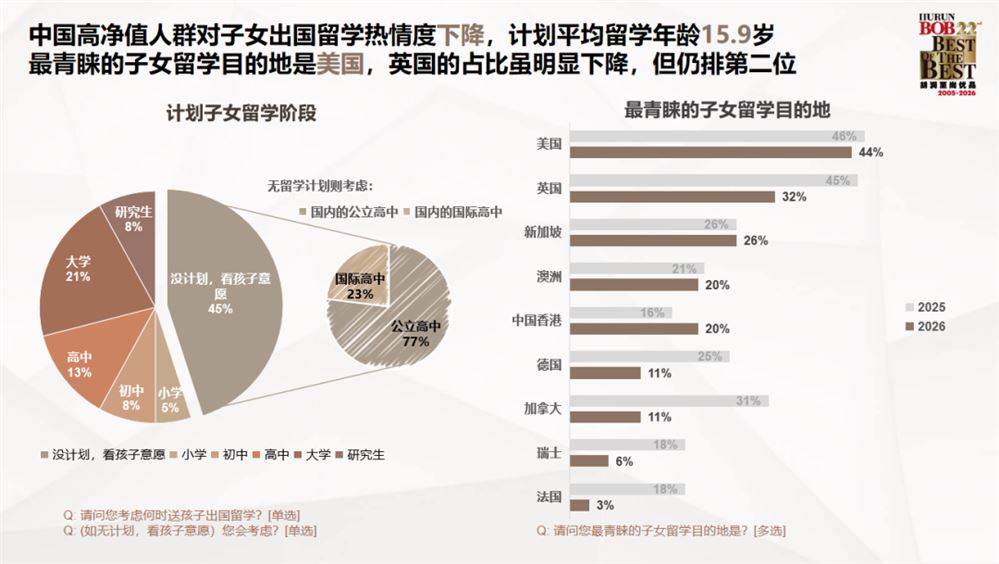
The report shows that although overall enthusiasm for studying abroad has declined, more than half of high-net-worth families still plan to send their children overseas for education, mainly at the university level, with an average planning age of 16; ultra-high-net-worth families plan even earlier, starting at an average age of 14.
It is also worthy of note that the preferred study abroad destinations are becoming clearly concentrated: the United States has maintained its position as the most preferred destination for children's education for three consecutive years.
International Identity Planning Destination
The United States is the Core Choice
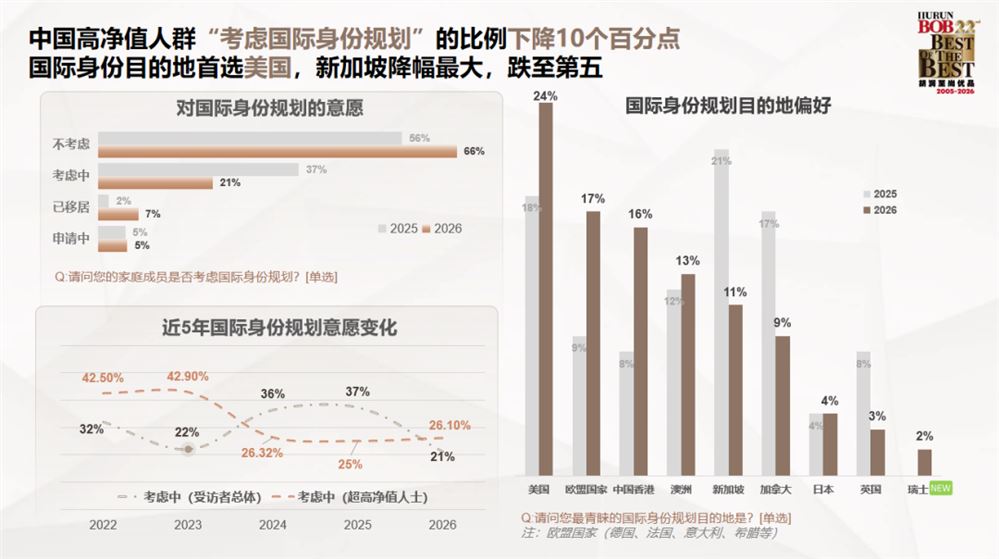
In addition to children's education, high-net-worth families show new trends in judgments regarding international identity planning. The report indicates that the United States ranks high in preference for identity planning destinations, with increased attention to EU countries and Hong Kong, China.
This suggests that considerations for identity allocation have moved beyond travel convenience or short-term arrangements to focus more on system stability, resource integration capacity, and the sustainability of future life and development. Identity is becoming a fundamental element of long-term family planning.
Education, Identity, and Asset Allocation
Moving Towards Integrated Consideration
In addition to children's education and international identity planning, high-net-worth families are also becoming more cautious about overseas investment decisions.
According to the report, in terms of investment directions over the next year, the overall allocation style clearly tends towards stability and risk aversion: the intent to net increase holdings in gold reaches 15%, ranking first; the net growth intention for overseas investment is 7%, with U.S. and Hong Kong stocks being the first choice; the net growth intentions for funds and insurance are both 6%. Meanwhile, 84% of high-net-worth individuals are still considering overseas investments, but investment destination preferences are further concentrating, with Hong Kong and the United States continuing to be the primary directions.
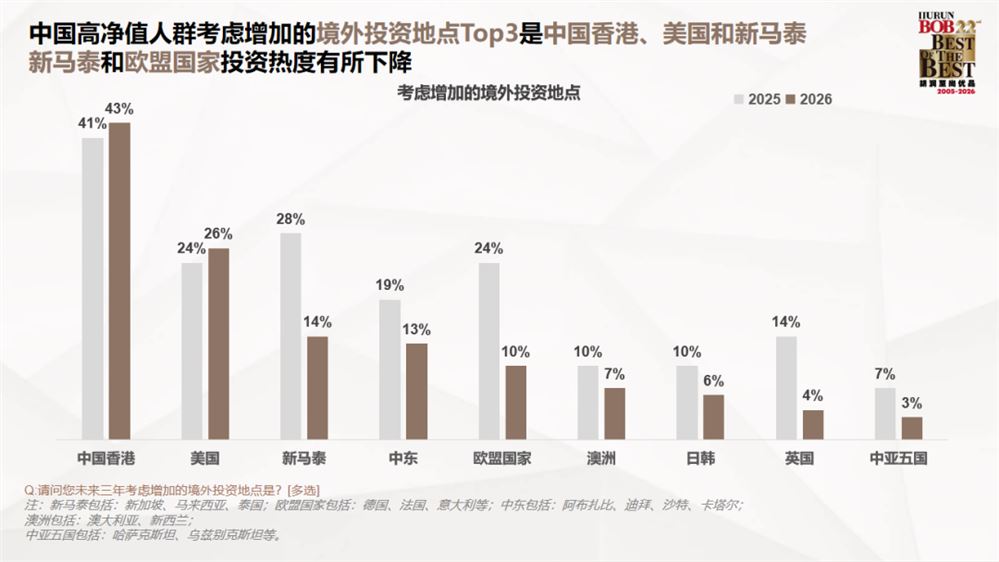
Considering children's education, international identity, and overseas investment together, a clear trend is emerging: high-net-worth families are beginning to consider education, identity, and asset allocation within the same framework. For them, these three are no longer independent decisions but require mutual support and collaborative long-term arrangements.
They are no longer just focusing on a single advantage but rather on whether a sustainable path can be pursued that supports the family's future development. This is why the U.S. EB-5 is under consideration because it meets not only identity needs but also a family's overall planning for future life and development.
Under the current policy framework, the new EB-5 investor immigration bill provides applicants with a relatively clear path: the rural EB-5 project is currently not subject to waiting periods and enjoys priority processing; eligible applicants can also "dual file," submitting both the I-526E immigration application and the I-485 status adjustment application while also applying for travel permit I-131 and work permit I-765, thereby gaining earlier access to work, entry, and exit conveniences in the U.S., securing more stability for future identity transitions.
World Trade Tong holds two high-quality EB-5 rural projects, assisting investors in realizing American identity planning with stability, no waiting periods, and efficiency, quickly embarking on a new life in the U.S. Global quotas are limited, seats are scarce, first come, first served!