Breaking News! US Visa Deposit Policy Expanded to 50 Countries
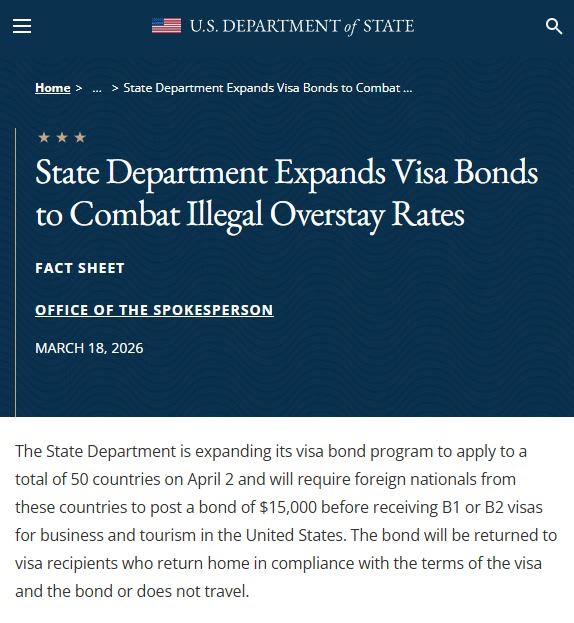
On March 18, 2026 local time, the US Department of State officially updated the list of countries applicable for visa deposits, expanding it to 50 countries, and clarifying that some newly added countries will be implemented starting from April 2, 2026.
Applying for B1/B2 Visas
May Require a Deposit First
According to current rules, certain applicants from countries on the list, may be required to pay deposits of $5,000, $10,000 or $15,000 when applying for US B1/B2 business or tourist visas.
Whether a deposit is needed and the specific amount will be determined by the consular officer based on individual circumstances; if the applicant exits on time and complies with visa regulations, the deposit can be refunded.

12 New Countries: Cambodia, Ethiopia, Georgia, Grenada, Lesotho, Mauritius, Mongolia, Mozambique, Nicaragua, Papua New Guinea, Seychelles, Tunisia.

Original 38 Countries: Algeria, Angola, Antigua and Barbuda, Bangladesh, Benin, Bhutan, Botswana, Burundi, Cape Verde, Central African Republic, Ivory Coast, Cuba, Djibouti, Dominica, Fiji, Gabon, Gambia, Guinea, Guinea-Bissau, Kyrgyzstan, Malawi, Mauritania, Namibia, Nepal, Nigeria, Sao Tome and Principe, Senegal, Tajikistan, Tanzania, Togo, Tonga, Turkmenistan, Tuvalu, Uganda, Vanuatu, Venezuela, Zambia, Zimbabwe.
What's Worth Noting
Is Not Just Paying More Money
On the surface, this seems to be just an adjustment in the visa application process; but in reality, it reflects stricter and more uncertain management of short-term entries by the US.
In the past, many families viewed business and tourist visas as a “transitional means” to the US —— to visit first, arrange first, and then make further plans later.
But now, the variables that this thinking faces are obviously increasing: the smoothness of the visa application itself, the requirement for high deposits, and how future stay records will affect subsequent plans will all become issues that need serious consideration.
This also means, the matter of going to the US is shifting from “Can you go once” to “Can you have a more stable way to go”. And that is precisely the issue many families now need to rethink.
What Really Needs to Be Considered
Is a More Stable Identity Path
For those who truly have needs for US education, family landing, asset arrangements, or long-term life planning, short-term visas are ultimately just temporary tools. They can address immediate travel needs, but are difficult to support long-term arrangements. Especially in the context of continuous policy tightening, the more one relies on temporary identity, the more one is susceptible to external changes.
And because of this, more and more families have begun to refocus on “identity planning” itself.
Because the core of identity planning has always been not just to solve a one-time entry, but to seek more certainty for future family arrangements. The educational path for children, the travel freedom for family members, the future landing rhythm, the configuration of assets and lifestyle, all rely on a more stable, clear identity foundation.
Why More People
Are Refocusing on Identity Planning
In such a policy environment, the value of EB-5 investment immigration is becoming increasingly prominent.
Unlike short-term visas, EB-5 itself is an immigration path aimed at US permanent residency. Under the current policy environment, its value is becoming increasingly prominent.
According to the US Department of State's Visa Bulletin, the EB-5 reserved visa category under the new Act currently remains in a state without a backlog; at the same time, the dual submission policy also provides a more efficient identity transformation path for domestic applicants in the US, allowing simultaneous filing of I-526E and I-485 to enter the identity adjustment process earlier. Additionally, rural projects enjoy priority review advantages, which are more concerned in the current application environment.
This also means that the significance of EB-5 has long surpassed merely applying for a green card; it provides a clearer, more stable, and more certain identity configuration path for families with long-term planning needs, against the backdrop of continuously increasing thresholds for entering the US and growing uncertainty of short-term visas.
Seize the window period, the earlier you plan, the more control you have. World Trade Center holds two high-quality EB-5 rural projects, helping investors achieve US identity planning steadily, with no backlog, and efficiently. Global quotas are limited and seats are scarce—first come, first served!