Alert for Maintaining Status in the US! Stricter Scrutiny on US Non-Immigrant Visas Imminent
On March 25, 2026, the U.S. Department of State issued a new announcement, releasing a very clear signal again: The environment for U.S. visas continues to tighten.
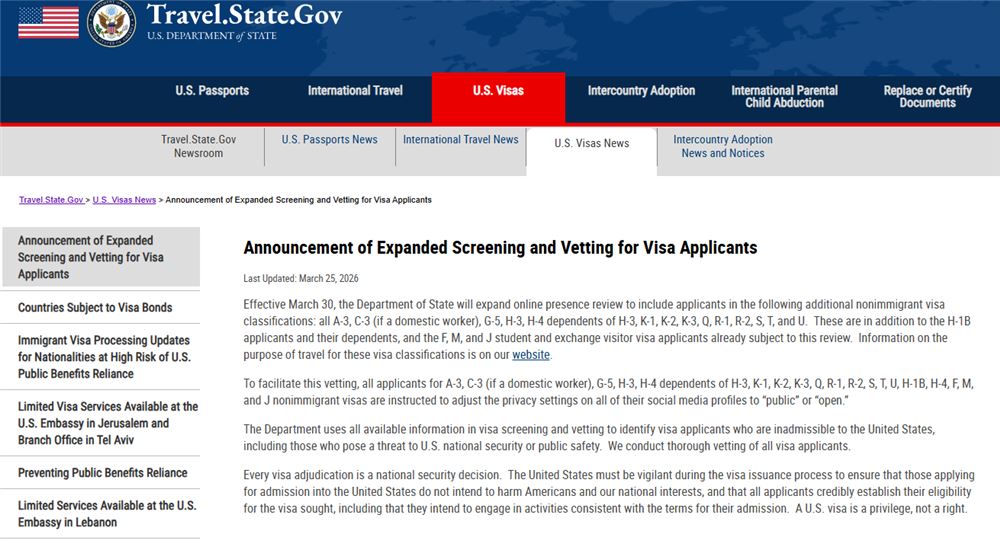
According to the announcement, starting March 30, the U.S. Department of State will further expand the scope of online information scrutiny for non-immigrant visa applicants. They require relevant applicants to set all their social media accounts' privacy settings to “public” or “open”.
The scope of scrutiny further expands
Additional 14 visa categories
According to the announcement, additional applicants are applied to the following non-immigrant visa categories:
• A-3, C-3 (such as domestic employees)
• G-5, H-3, H-4 (family of H-3)
• K-1, K-2, K-3 (marriage visas)
• Q (cultural exchange)
• R-1, R-2 (religious type)
• S, T, U visa types
These categories are additional to the original scope. Previously, H-1B applicants and their families (H-4), as well as F, M, J student and exchange visitor visa applicants were already included in this scrutiny. (For more details, please check the previous report by World Trade Passport: US Visa Alert! New Round of H-1B Status Siege Is Imminent)
In other words, the U.S. online scrutiny for non-immigrant visa applicants is expanding from specific categories to a broader crowd. In other words, social media, public expression, and online history are becoming routine content of U.S. visa scrutiny.
Applicants need to open social media permissions
The announcement clearly requires, all affected visa category applicants need to set their social media accounts' privacy settings to “public” or “open”.
The U.S. Department of State emphasizes that they will use all available information to screen and examine visa applicants to identify those who do not qualify to enter the U.S., including those who may pose threats to U.S. national security or public safety. A comprehensive review is conducted for all visa applicants.
More notably, the U.S. Department of State reiterates: Every visa decision is a national security decision. The U.S. must remain vigilant during the visa issuing process to ensure that those applying to enter the U.S. do not intend to harm American citizens or damage U.S. national interests, ensuring all applicants can credibly prove they meet the qualification requirements for the visa they applied for, including that their intended activities will align with their approved conditions of entry. A U.S. visa is a privilege, not a right.
Short-term visas are becoming stricter
Long-term identity planning value becomes prominent
The signal behind reveals very clearly: In the future, short-term visas will increasingly focus on “reviewable, interpretable, and verifiable”. For those who already have a need for long-term development, child education, family residence, and life planning in the U.S., solely relying on temporary visas will only face higher uncertainty in the future. Those truly needing long-term access to the U.S. need to shift from “visa thinking” to “identity thinking” as time goes on.
As the uncertainty of temporary visas continues to rise, pathways leading directly to long-term legal identity will become more valuable. For families wishing to achieve simultaneous setup for U.S. residence, child education, family planning, and identity stability, EB-5 is no longer just a migration project, but a more determined long-term identity solution.
Under the new law, applicants can make “dual submissions” in the U.S., meaning applicants without a waiting period can simultaneously submit the I-526E immigration application and the I-485 adjustment status application, and also simultaneously apply for travel permit I-131 and work permit I-765, achieving legal work, free entry and exit, and enjoying green card-like convenience in advance for life and work.
According to the U.S. Department of State visa announcement, the reserved visa categories under the new EB-5 bill currently remain in no waiting period status. Moreover, rural projects enjoy priority review advantages. Most importantly, the current EB-5 policy remains protected by the “grandfather clause”, allowing applications submitted before September 30, 2026, to lock in the current policy framework, unaffected by future legislative changes.
However, it is worth noting that this window will not persist for a long time. The grandfather clause will expire on September 30; The minimum investment amount may increase from 800,000 USD to 900,000 USD or even higher by January 1, 2027. Additionally, once quotas appear in the reserved categories of the new EB-5 policy, the current “no quotas + dual submission” golden window will end. For families truly valuing U.S. long-term identity planning, the earlier they start, the more they can hold the initiative in their own hands.