Big Changes in US Visas! Families Taking One Step at a Time Are in Danger
In the past, many families had a similar approach when planning for the US. They would first apply for a tourist visa to visit and take a look. When the children needed to study, they'd apply for a student visa. After graduation, whether they can work or stay would be considered step by step. The issue of status would be considered seriously when the need arises.
However, now the US legal entry environment is tightening. The uncertainties of traditional visa paths are clearly increasing, with changes in the pace of issuance, scrutiny scales, and processing efficiency happening simultaneously. The previously relatively stable paths to the US are being reordered.
According to data released by the US Department of State, in the first 8 months of 2025, the number of various US visa issuances fell by approximately 250,000 compared to the same period in 2024, a decline of about 11% overall. This includes various immigrant visas and various non-immigrant temporary visas other than B-category short-term business/tourism visas.
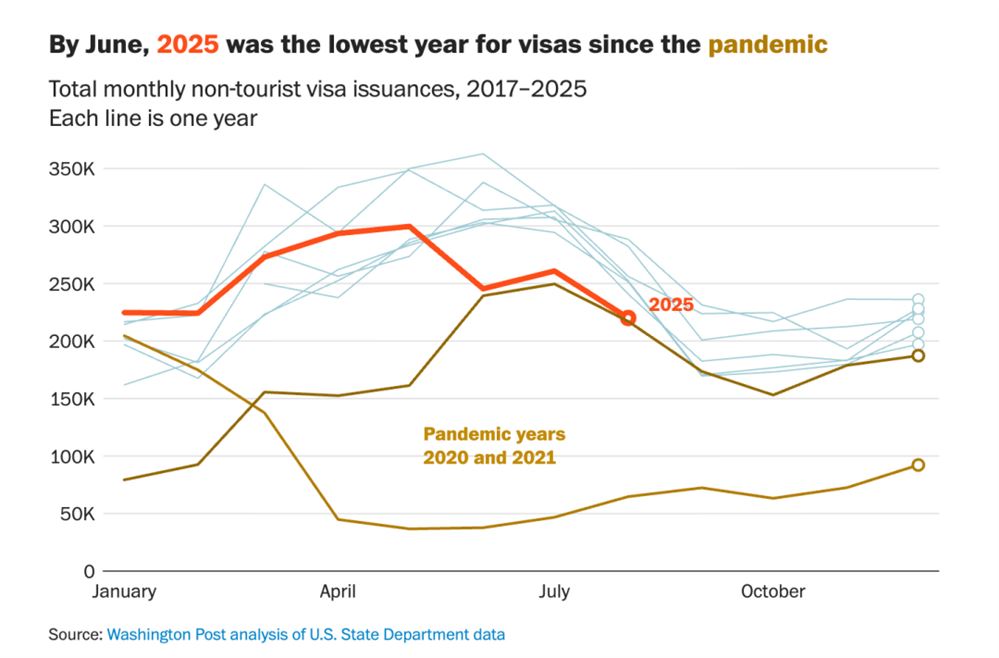
Among them:
• F-1 Student Visa: The group of international students is the most affected, with visa issuance down more than 30%.
• B-category visa (Business/Tourism/Family Visit): Issuance reduced by nearly 200,000, a decrease of approximately 3.4% compared to the same period last year.
• Work and Family Visas: H-1B, L-1, and other work visas, as well as family reunion immigrant visas restricted by quotas, have contracted in synchronization. Among them, family category visas restricted by quotas have plummeted by 27%.
The signal from this set of data is already clear: This is not a localized fluctuation in one visa category, but a tightening of the overall visa issuance environment.
Additionally, from a country standpoint, applicants from China and India are notably impacted. The total number of US visas obtained by citizens of these two countries decreased by approximately 84,000, with visas issued to Chinese nationals dropping by 24%. This reflects not just a change in quantity but also a holistic tightening in US visa processing procedures, scrutiny scales, and resource allocation.
and Also Focuses on Risk Control
In addition to the decline in total numbers, some recent rule-level changes also emit similar signals.
For example, the latest update from the US Department of State expands the visa bond program to 50 countries, clearly stating that part of the newly added countries will be included for implementation starting April 2, 2026. (For details, please refer to the previous report from WTP: Breaking! US Visa Bond New Policies Expand to 50 Countries) For some applicants from listed countries applying for the US B1/B2 business or tourist visa, they may be required to post a bond ranging from $5,000 to $15,000.
Meanwhile, visa reviews are becoming significantly more stringent:
• Expansion of background checks: Mandatory checks on all applicants' social media accounts have been introduced, along with more complex background checks, objectively prolonging the review process.
• Tightening of discretionary powers: At the visa officer level, scrutiny over "immigration intent" has become more stringent.
• Applications must be filed in the nationality or residence country: All non-immigrant visa applicants (including B1/B2, F1, H1B, L1, etc. common categories) must submit their applications at the consulate in their nationality or legal long-term residence country.
Signs collectively indicate that in visa management, the US is emphasizing pre-screening, risk stratification, and accountability.
Identity Planning Should Be Front-Loaded
For families that truly have long-term plans, what deserves more attention is which path should be taken in the future for stability and control.
A tourist visa can solve short-term travel,
A student visa can solve stage-specific studies,
A work visa can solve a certain period of career stay,
but all these paths increasingly rely on the pace of review, appointment windows, case examination, and policy scales.
Because of this, EB-5 US investment immigration, as a key method in US long-term identity planning, is increasingly valuable. The reason is simple: EB-5 is not a short-term stay visa, but a path directly leading to long-term identity as a US green card.
From the current policy environment, EB-5 is still in a worthwhile window of opportunity. According to the US Department of State visa bulletin, the EB-5 reserved visa categories under the new law are currently maintaining no backlog status; moreover, the dual-filing policy provides a more efficient path for status adjustment for US-based applicants. Additionally, rural projects enjoy priority approval benefits.
But it is worth reminding that this window will not last indefinitely. Grandfathering Clause will expire on September 30th; the minimum investment amount could rise from $800,000 to $900,000 or even higher on January 1, 2027. Furthermore, if the EB-5 new policy reserved categories face backlogs, the current "no backlog + dual-filing" golden window will end. Therefore, the earlier high-quality, I-956F approved rural projects are locked in, the more proactive position in identity planning can be maintained.