Breaking Proposal: Abolition of H-1B?
H-1B brings big news again! Just as discussions about raising the H-1B wage threshold are not yet settled, another major announcement has emerged in the U.S. immigration community.
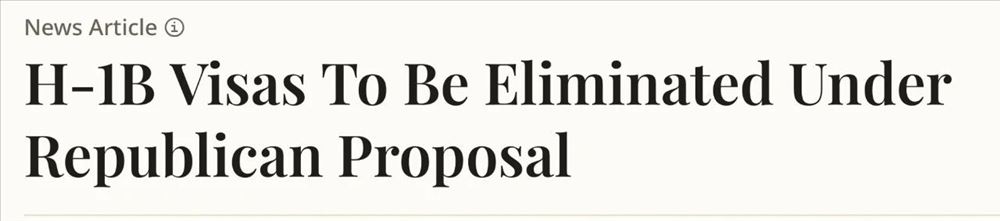
According to Newsweek, Republican Congressman Andy Ogles from Tennessee has submitted a new bill to Congress - the 'Assimilation Act,' which plans to completely discontinue the green card lottery system and terminate the H-1B visa program entirely. Some media have described this proposal as the 'most significant immigration reform of the century.'
1. What exactly does this draft aim to change?
Based on currently disclosed content, the bill primarily aims to do three things:
First, abolish the H-1B work visa program;
Second, eliminate the Diversity Immigrant Visa lottery (commonly known as the 'green card lottery');
Third, weaken the emphasis on family immigration, and shift towards a model that emphasizes 'national interest,' 'cultural assimilation,' and 'security screening,' while strengthening background checks and social media scrutiny.
In other words, this draft proposal is not simply about adjusting thresholds, but aims to tighten several common legal immigration pathways simultaneously. For international students, foreign professionals, and U.S. companies relying on international talent, such a proposal understandably brings significant impacts.
The draft states: 'All immigrants entering the United States must serve the economic, cultural, and national security interests of the United States.' Although the proposal is unlikely to be implemented soon, the signal it releases is very clear: U.S. immigration policy is accelerating towards a 'high-skill, high-wage, strict selection' direction.
2. H-1B is becoming increasingly unstable
Why does this news make so many people nervous? Because H-1B has long been the primary channel for many international students to work in the U.S.
Under current rules, the regular H-1B quota remains 65,000 general places annually plus 20,000 places for those with a master's degree or higher from U.S. institutions. Moreover, the new wage-weighted selection mechanism has officially been applied to the FY2027 H-1B registration season, with the selection logic placing greater emphasis on high-wage and high-skill positions. In other words, obtaining an H-1B has already become increasingly difficult in recent years.
Meanwhile, the U.S. Department of Labor has announced a proposed rule preparing to significantly increase the H-1B visa's 'minimum wage standard,' with a public comment period ending May 26, 2026.
This means that the cost for employers to secure visas for foreign employees might further increase in the future. The proposal of the 'Assimilation Act' pushes this trend to the extreme—the fate of H-1B could now be not just a matter of 'high or low thresholds,' but a test of 'existence or non-existence.'
3. Staying in the U.S. can't rely solely on H-1B
Many used to think that as long as they first found a job and then entered the H-1B lottery, subsequent identity issues would eventually be resolved.
But the current reality is that any change in job opportunities, employer willingness, lottery results, wage threshold, or policy shifts might alter the entire path. As a result, more and more families are realizing that planning to stay in the U.S. cannot depend solely on one lottery result, and consideration of long-term identity arrangements should start as early as possible.
Put more directly, staying in the U.S. increasingly cannot rely on 'luck,' but must depend on 'planning.'
4. Breaking the deadlock: EB-5 new law window
This is a crucial period for early planning
Under the current circumstances, more and more families are turning to EB-5, for a straightforward reason: H-1B addresses the work visa issue, while EB-5 focuses more on the certainty of long-term identity.
Compared to H-1B, the biggest difference with EB-5 is that it does not depend on an employer, does not participate in a lottery, and allows applicants more control in identity planning. Currently, EB-5 is in a window period worth taking advantage of:
• Under the new law, EB-5 reserved visa categories remain in a status without a backlog
• Dual filing, simultaneous submission of the I-526E immigration application and the I-485 status adjustment application
• Legal long-term stay, simultaneous application for work permits and re-entry permits
• Identity is no longer dependent on the employer
• Rural projects also enjoy priority review advantages
It is worth noting that this window will not remain indefinitely. The widely watched key timeline, with the grandfathering clause expiring on September 30; the minimum investment amount likely increasing from $800,000 to $900,000 or higher on January 1, 2027. Moreover, once the backlog appears in EB-5 reserved categories, the current 'no backlog + dual filing' golden window will close. In other words, the earlier the planning, the better the chance to secure the current advantages.