Under the Storm of U.S. Citizenship Revocation, Who Can Stay?
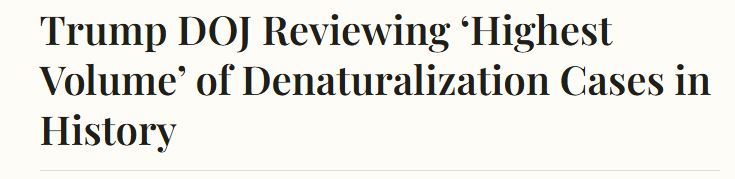
Recently, the U.S. government's statement on strengthening the enforcement of 'citizenship revocation' has drawn significant attention from the immigration industry and applicants. According to reports, the U.S. Department of Justice has confirmed that the citizenship of approximately 384 individuals may face revocation risks, with related cases primarily targeting instances of fraud, concealment, or failure to meet statutory requirements during the naturalization process.
This sends a clear signal: the U.S. immigration system is entering a phase that emphasizes authenticity, transparency, and long-term compliance.
Stricter Immigration Oversight
Compliance Reviews Become a Focus
Historically, citizenship revocation cases were relatively rare. From 1990 to 2017, the U.S. Department of Justice filed a total of 305 such cases, averaging about 11 cases per year. During Trump's first term, this number rose to 168 cases over four years; under Biden, about 64 cases. According to currently disclosed information, since January 20, 2025, 15 individuals have had their citizenship revoked, involving 22 cases. More notably, relevant departments are pushing to increase case submission efficiency, with some officials aiming for at least 200 cases submitted per month, indicating that similar enforcement may proceed at a higher frequency in the future.
These figures indicate that the U.S. is not suddenly changing its legal rules but is instead strengthening the enforcement of existing laws. For applicants, the real concern should be whether their application path is sufficiently authentic, complete, and compliant to withstand future ongoing scrutiny.
The Era of Strong Regulation
Compliance Paths Hold Long-Term Value
The U.S. strengthening the retrospective investigation of naturalization fraud does not mean that legal immigration channels are closed. In 2024 alone, more than 818,000 people completed naturalization and became U.S. citizens. The real focus is on cases involving fraud, concealment, or failure to meet requirements during the application process.
Therefore, for families planning to immigrate to the U.S., the key is to understand the trend: future U.S. immigration reviews will place greater emphasis on authenticity and compliance. The earlier applicants choose a compliant path, the lower the uncertainty they will face later.
Advantages of EB-5:
Regulated Path, Mature System
In the context of 'strong compliance' becoming the main theme, the institutional advantages of the U.S. EB-5 investment immigration program are increasingly prominent.
Firstly, EB-5 has extremely strict requirements for the source of funds. Secondly, EB-5 adopts a phased review mechanism, with the U.S. Citizenship and Immigration Services conducting ongoing reviews of investment compliance and project implementation. Furthermore, the EB-5 program itself has been operating for over 30 years, with a highly mature legal framework and operational path. EB-5 emphasizes 'genuine investment + compliance proof,' aligning closely with the current U.S. policy direction.
It can be said that the value of EB-5 is not just in helping applicants obtain green cards but also in establishing a solid foundation for identity security through a complete legal and documentation system.
Currently, the EB-5 program under the new law is still in a relatively favorable policy window. For example, rural EB-5 projects currently enjoy no waiting period and priority review advantages; at the same time, the 'dual filing' policy allows eligible applicants to simultaneously file I-526E and I-485 within the U.S., obtaining a Combo Card in about three months, thereby securing legal residency, work permits, and travel convenience as soon as possible.
However, this window will not last long. As reserved visa quotas continue to be consumed, waiting period pressures are gradually emerging; meanwhile, the grandfather clause will expire on September 30; the minimum investment amount may also increase from $800,000 to $900,000 or even higher on January 1, 2027. In other words, for families planning U.S. immigration, the earlier they start, the greater the opportunity to lock in the relatively clear and favorable policy conditions of the present.