OPT Suspension Alarm: Staying in the U.S. Cannot Be a Waiting Game!
The spring of 2026, which should have been a critical moment for international students transitioning from campus to the workplace, was forced to pause due to a policy adjustment.
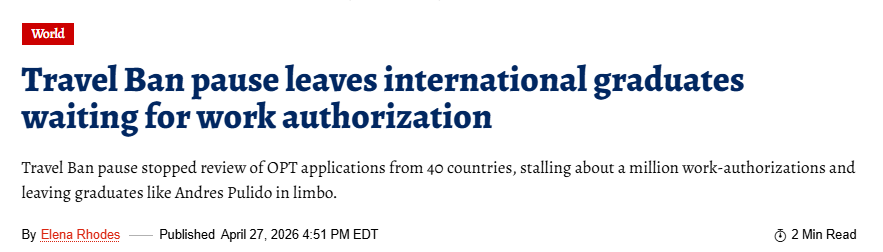
According to multiple media reports, the U.S. government has expanded the scope of the “Travel Ban” in a series of statements, one of which includes: suspending the processing of certain immigration benefits for applicants from about 40 countries and regions, including the post-graduation work permit (OPT, Optional Practical Training) that countless international students rely on to stay in the U.S. As a result, a large number of OPT applications are stalled, and even students who submit their materials on time can only wait in uncertainty for a result with no timeline.
This sends a clear signal: The U.S. immigration system is entering a phase that emphasizes authenticity, transparency, and long-term compliance.
The 'Darkest Hour' of OPT:
Increased Uncertainty in the Path for International Students
As a core transitional tool for international students to stay in the U.S., OPT has always played the role of the starting point for “graduation→employment→H-1B→green card.” However, under the current circumstances where the U.S. Citizenship and Immigration Services (USCIS) has not clarified the new review rules, the suspension of OPT processing for applicants from certain countries has caused a break in this path at its very beginning.
Administrative Black Hole:
The U.S. Citizenship and Immigration Services has suspended the approval process for applicants from about 40 countries and regions under the pretext of implementing “new review rules.” Although forms can still be submitted, cases seem to disappear into a void, neither being reviewed nor rejected.
Indefinite Waiting:
This measure, originally claimed to be “temporary,” has lasted for more than four months. It is estimated that the total number of affected applications under this policy exceeds 2 million, with about 1 million work permit applications stalled.
The Invisible List:
The list of 40 affected countries and regions has not been fully disclosed by the U.S. government. This lack of transparency has heightened panic. As rights advocates have pointed out, students are falling into a “review black hole” with no clear direction.
From a systemic perspective, applications can still be submitted, but cases enter a state of “pending but not reviewed.” This state means that the path is not closed, but it cannot move forward either. For graduates who have already secured job offers and are ready to start work, this uncertainty translates directly into real losses——inability to start work, canceled contracts, or even being forced to leave the city they had planned to settle in.
More importantly, OPT is not an isolated step; it is often connected to subsequent H-1B applications and green card planning. Once the starting point is delayed, subsequent status arrangements may also be disrupted.
Breaking the Deadlock: EB-5
Taking Control of Your Own Destiny
The stagnation of OPT approvals once again reveals a reality: the international student path fundamentally relies on multiple uncertain variables——policy changes, employer support, H-1B lottery results, timely approvals, etc. Any fluctuation in one link can affect subsequent status planning.
Instead of passively waiting amidst policy changes, it is better to establish a more certain status path in advance. Unlike the traditional international student path, EB-5 does not rely on employment opportunities or H-1B lottery quotas. Its core logic is to apply for a U.S. green card through investment, providing applicants and their families with a relatively independent and plannable immigration channel, putting the future in their own hands.
Currently, the EB-5 new law is still in a relatively favorable policy window. For example, rural EB-5 projects currently enjoy no waiting period and have priority review advantages; meanwhile, the “dual filing” policy allows eligible applicants to simultaneously submit I-526E and I-485 within the U.S., obtaining a Combo Card in about three months, thereby quickly gaining legal residency, work permits, and travel convenience.
However, this window will not last long. As reserved visa quotas continue to be consumed, waiting period pressures are gradually emerging; at the same time, grandfathering provisions will expire on September 30; and the minimum investment amount may increase from $800,000 to $900,000 or even higher on January 1, 2027. In other words, for families planning U.S. status, the earlier they start, the more likely they are to lock in the relatively clear and favorable policy conditions of the present.