U.S. Visa Review Tightens Again!
Recently, U.S. visa scrutiny has drawn attention again. On April 28 local time, the U.S. Department of State issued an urgent notice to embassies and consulates worldwide: effective immediately, all applicants for U.S. non-immigrant visas must answer two additional questions during their interviews!
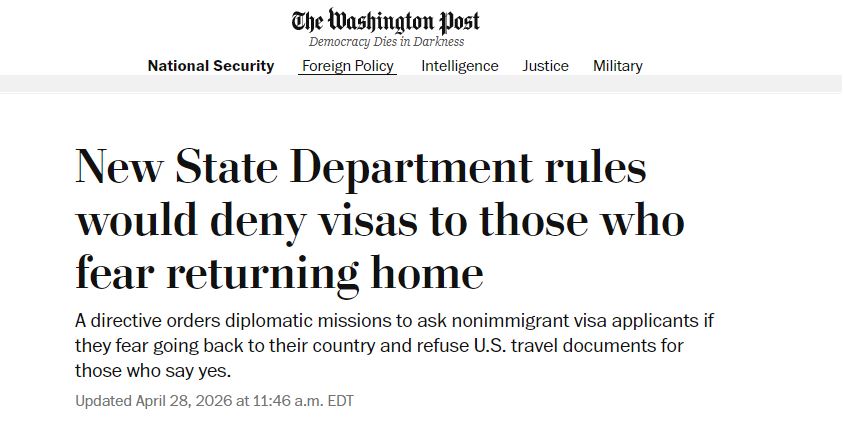
The new regulations clearly state that embassies and consulates abroad must ask applicants the following two questions when processing non-immigrant visa applications:
1. Have you ever been harmed or abused in your country of nationality or last habitual residence?
2. Are you afraid of being harmed or abused if you return to your country of nationality or permanent residence?
Only if the applicant verbally answers “no” to both questions can the visa review process proceed; if the applicant answers “yes”, the visa will be denied on the spot.
The sensitivity of this new regulation lies in the fact that it not only affects the current visa outcome but may also impact the applicant's future status applications within the U.S., putting the applicant in a dilemma.
If the applicant answers “yes”, admitting fear of returning home, the visa officer may deem them ineligible for the temporary visit nature required by non-immigrant visas, thus denying the visa.
If the applicant answers “no”, but later applies for asylum after entering the U.S., the U.S. government may retrieve the interview records from the visa stage and question whether there was false representation initially. If deemed fraudulent, they will face permanent visa denial and deportation.
This new regulation, combined with multiple policies, further escalates the difficulty of U.S. visa applications:
Starting March 30, 2025, the U.S. Department of State will expand the scope of online identity checks, requiring applicants for 14 types of non-immigrant visas, including F1 student visas, to set all their social media profiles to public.
Meanwhile, the U.S. Department of State is also tightening the interview waiver policy. Starting October 2025, most non-immigrant visa applicants will, in principle, need to attend interviews, with only a few categories and eligible short-term renewal applicants possibly exempted.
Additionally, the U.S. is expanding the visa bond policy. Starting April 2, 2026, applicants from certain countries may need to pay a bond of up to $15,000 when applying for a U.S. visa to reduce the risk of overstaying.
At the same time, efforts to combat immigration fraud and related illegal activities will be intensified, and some past approval cases will be reviewed, including green cards and other immigration benefits approved during the Biden administration.
H-1B visa-wise, the random lottery will be abolished, and a weighted lottery based on salary levels will be implemented, giving higher-paid applicants a better chance, while opportunities for ordinary graduates will sharply decrease.
Together, these policies indicate that U.S. immigration scrutiny is forming a more complete loop: checking intentions before the visa, observing behavior after entry, and reviewing material consistency and background records when applying for immigration benefits.
For families with a genuine long-term need to move to the U.S., the implications of policy changes are very clear: if the goal is only short-term tourism, business, family visits, or study, materials should be prepared according to the logic of the corresponding non-immigrant visa; but if the family already has plans for long-term living, children's education, asset allocation, career development, or even permanent residency in the U.S., they should not rely on non-immigrant visas to carry immigration goals.
The focus of non-immigrant visas is “temporary visit”; the focus of immigration paths is “long-term residence”.
Therefore, for high-net-worth families, business owners, investors, and families wishing to plan U.S. education and identity development for their children in advance, it is advisable to evaluate early whether it is suitable to achieve U.S. identity arrangements that better match long-term goals through immigration paths such as EB-5.
Currently, under the new EB-5 law, there is still a relatively favorable policy window. For example, the Rural EB-5 Project currently enjoys no waiting period and has priority review advantages; meanwhile, the “dual filing” policy allows eligible applicants to simultaneously file I-526E and I-485 within the U.S., obtaining a Combo Card in about 3 months, thus securing legal residence, work permits, and travel convenience as soon as possible.
However, this window will not last long. As reserved visa quotas continue to be consumed, waiting pressure is gradually emerging; at the same time, the grandfather clause will expire on September 30; the minimum investment amount may also increase from $800,000 to $900,000 or even higher on January 1, 2027. In other words, for families intending to plan U.S. identity, the sooner they start, the more likely they are to lock in relatively clear and favorable policy conditions.