U.S. Immigration Approval Suspended? Truth Explained
Recently, a piece of news about “U.S. immigration approval suspension” has attracted attention on social media. Many families who are in the process of obtaining U.S. status, preparing to study in the U.S., or planning for a U.S. green card have started to worry about whether their applications will be affected.
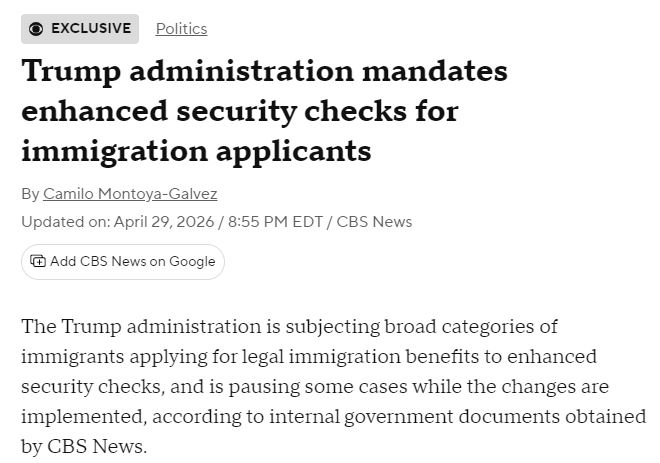
However, it must be clarified that this is not “a complete suspension of immigration approval by USCIS.” What truly deserves attention is that U.S. immigration reviews are further strengthening safety background checks and compliance requirements.
It is not a complete suspension
but rather a tightening of background review standards
More accurately, starting from April 27, 2026, U.S. time, USCIS will implement a more stringent FBI background check mechanism for certain immigration benefit applications requiring fingerprint submission. Some cases already under review, such as green card adjustment of status, naturalization, and asylum, may be temporarily delayed for final approval if their previous fingerprint checks have not gone through the new system.
This means that in the short term, some cases may experience approval delays. However, there is currently no evidence to suggest that all immigration applications have been suspended, nor does it mean that applicants will be uniformly denied.
Therefore, applicants should not be misled by the claim of “complete suspension.” A more accurate understanding is: U.S. immigration approvals are still ongoing, but the safety background check standards for some cases have been raised.
Safety and Compliance
are becoming the focus of U.S. immigration reviews
This policy adjustment sends a signal that is more noteworthy than the short-term delays themselves.
In recent years, U.S. immigration reviews have increasingly emphasized applicants' safety backgrounds, material authenticity, and compliance records. The strengthening of FBI background checks also indicates that immigration approvals are shifting further towards more comprehensive background checks, reflecting a trend towards greater standardization of U.S. immigration applications.
For families planning to obtain a U.S. green card, these adjustments in review mechanisms further highlight the importance of early planning. The earlier families clarify their goals, financial arrangements, application timelines, and material preparation directions, the more beneficial it will be for the steady progress of subsequent applications.
Especially when a family's goals have shifted from short-term U.S. arrangements to children's education, long-term residence, business development, and global asset allocation, choosing a clear goal, a well-defined planning cycle, and a comprehensive green card pathway becomes particularly important.
Under the Policy Window
EB-5 is more suitable for early planning
In the context of stricter U.S. immigration reviews and a greater emphasis on early planning for status arrangements, EB-5 investment immigration policy windows and long-term value are increasingly worth the attention of families planning for the U.S.
EB-5 immigration application conditions are lenient, with no strict requirements for age, education, language, business, or work experience backgrounds. Especially under the new EB-5 law, rural EB-5 projects are exempt from waiting periods and have priority review advantages, attracting the attention of many families. At the same time, the “dual filing” policy allows applicants in the U.S. to simultaneously submit I-526E and I-485, obtaining a Combo Card in about three months, quickly achieving legal residency and employment eligibility.
However, this window will not remain open indefinitely. As reserved visa quotas continue to be consumed, waiting period pressures are gradually emerging; meanwhile, the grandfather clause will expire on September 30; and the minimum investment amount may increase on January 1, 2027. In other words, for families intending to plan for U.S. status, the earlier they start, the better their chances of locking in the relatively clear and favorable policy conditions at present.