Sudden Change for Studying in the U.S.! H-1B Status Threshold Has Been Preceded
In the past, many families studying abroad tended to consider status issues after graduation: first study, then find an internship, work with OPT after graduation, see if they can get selected for H-1B, and finally plan for a green card.
But now, the U.S. job market is undergoing significant changes. The competition for international students no longer starts after graduation; the status threshold has already entered the internship application, campus recruitment, and employer screening stages. Many students have not even reached the OPT and H-1B stage but have already felt the gap caused by status during internships.
According to reports, the U.S. internship market is experiencing significant changes: fewer internship positions, more applicants, and companies are more cautious about hiring for junior roles.
Data from recruitment platforms show that the number of internship positions in early 2026 decreased by about 16% year-on-year; meanwhile, during the 2024-2025 academic year, each internship position received an average of 109 applications, compared to 62 the previous year, nearly doubling the competition. At the same time, the importance of internships in corporate recruitment systems is rising. Surveys show that the conversion rate of interns to full-time employees has reached a five-year high.
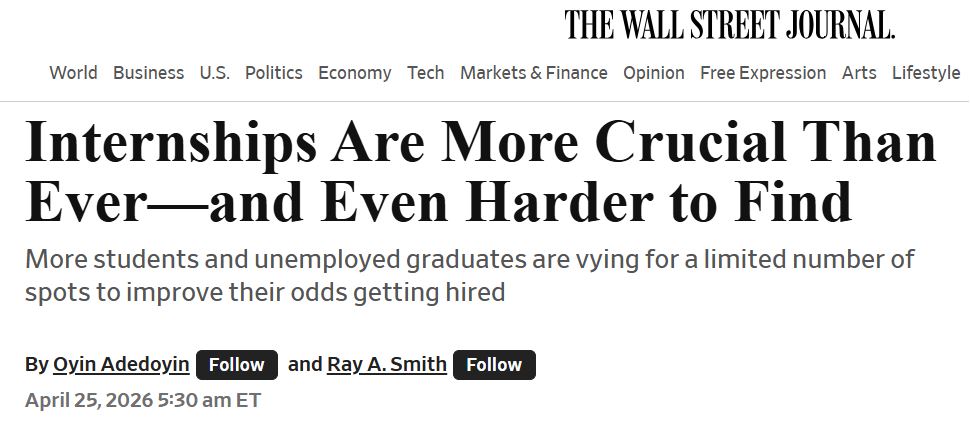
This is also why more and more American students start looking for internships as early as their freshman and sophomore years. Companies screen candidates earlier, students compete earlier, and the job-seeking pressure originally belonging to graduation season is continuously moving forward.
For international students, the difficulty of job seeking is not just due to fewer positions and more applicants; the more realistic issue is status restrictions. Many companies directly ask two questions during internship or full-time job applications: Do you currently have U.S. work authorization? Will you need employer sponsorship for a visa in the future?
These two questions may seem simple, but for international students, they are often the first filter. Handshake, in its official job-seeking advice for international students, also reminds: do not waste time applying to companies that do not provide sponsorship because even if you luckily get an internship opportunity, the company may not be able to formally hire you after graduation. This indicates that companies have long considered "whether sponsorship will be needed in the future" as an important screening criterion.
International students without a green card, even if they have good professional skills, still face uncertainties such as OPT duration, H-1B lottery, whether employers are willing to sponsor, and identity risks after layoffs. The traditional "F-1 student visa—OPT—H-1B—green card" path is not impossible, but it is highly dependent on external variables, and any change in one link may affect subsequent plans to stay in the U.S.
Students with green cards do not need employer sponsorship or face H-1B lottery issues. From the perspective of companies, these candidates offer greater employment stability, lower risks for conversion, and are more suitable for long-term cultivation.
All Indicate Status Thresholds Are Preceded
Recruitment information from some well-known companies further illustrates that status thresholds have already been preceded.
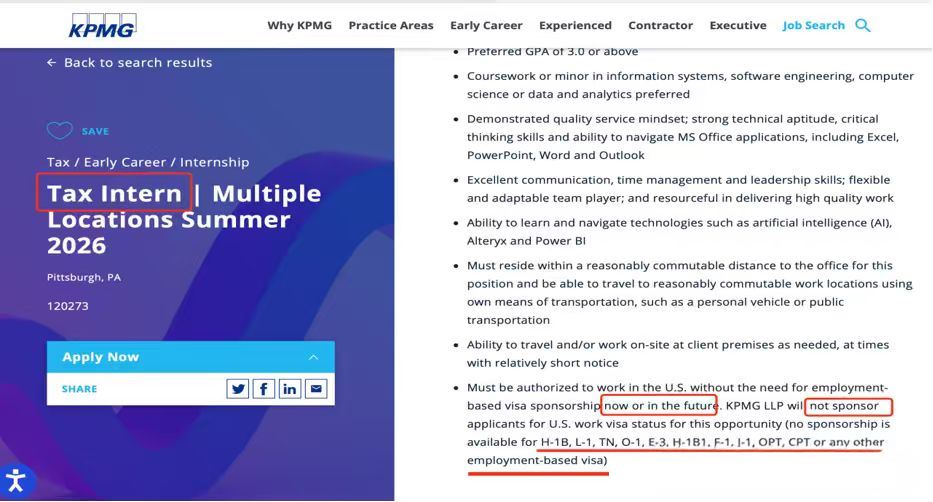
For example, KPMG explicitly states in some 2026 summer internship position requirements: applicants must already have U.S. work authorization and cannot rely on employment-based visa sponsorship now or in the future. Their description also clearly lists that they do not provide sponsorship for H-1B, L-1, TN, O-1, E-3, H-1B1, F-1, J-1, OPT, CPT, or other employment-based visas for this opportunity.
Some positions at Morgan Stanley also explicitly state that they do not sponsor international work visas.

This situation is also reflected in many international students' real job-seeking feedback. One student with F-1 OPT status shared on social media that he has a background in computer information systems and data analysis internship experience, but even after submitting numerous resumes, interview opportunities remain very limited. His feeling is very direct: "Once they find out I am an international student with OPT status, they immediately reject me."
Others discussing OPT/CPT international student recruitment trends mentioned that they had interned at a Fortune 20 company. Among over 120 interns, they knew only about 2 who held visa status, while most others were green card holders or U.S. citizens. The reason is very realistic: companies recruit interns essentially hoping to convert them into full-time employees in the future; if full-time positions are more inclined towards green card holders or U.S. citizens, then international students will naturally be affected during the internship stage.
Whether it is corporate recruitment requirements or real student feedback, they all point to the same issue: status is no longer just a problem to face after graduation but is already moving forward to internship applications, position screening, and conversion evaluations.
In the current environment, more and more families studying abroad are beginning to focus on EB-5 because it provides a path that does not rely on employers or H-1B lottery.
Under the new EB-5 law, the "dual filing" policy allows eligible applicants to simultaneously submit I-526E and I-485 within the U.S., obtaining a Combo Card in about three months, thereby quickly gaining legal residency, work authorization, and travel convenience. For students who are studying or about to enter the job-seeking stage, such planning helps enhance the initiative in internships and job choices.
It is worth noting that the EB-5 new policy's "grandfather clause" protection period will expire on September 30, 2026. Applications submitted before this date will continue to be processed under current legal rules even if future policies change.