Attention for Traveling to the US: New Non-Immigrant Visa Regulations to be Announced
Attention, families planning to study in the US should be aware of an important development: The US Department of Homeland Security (DHS) has submitted new regulations to terminate the “Duration of Status” for F, J, and I visas to the Office of Management and Budget (OMB) for review. These regulations are expected to be announced and implemented soon.
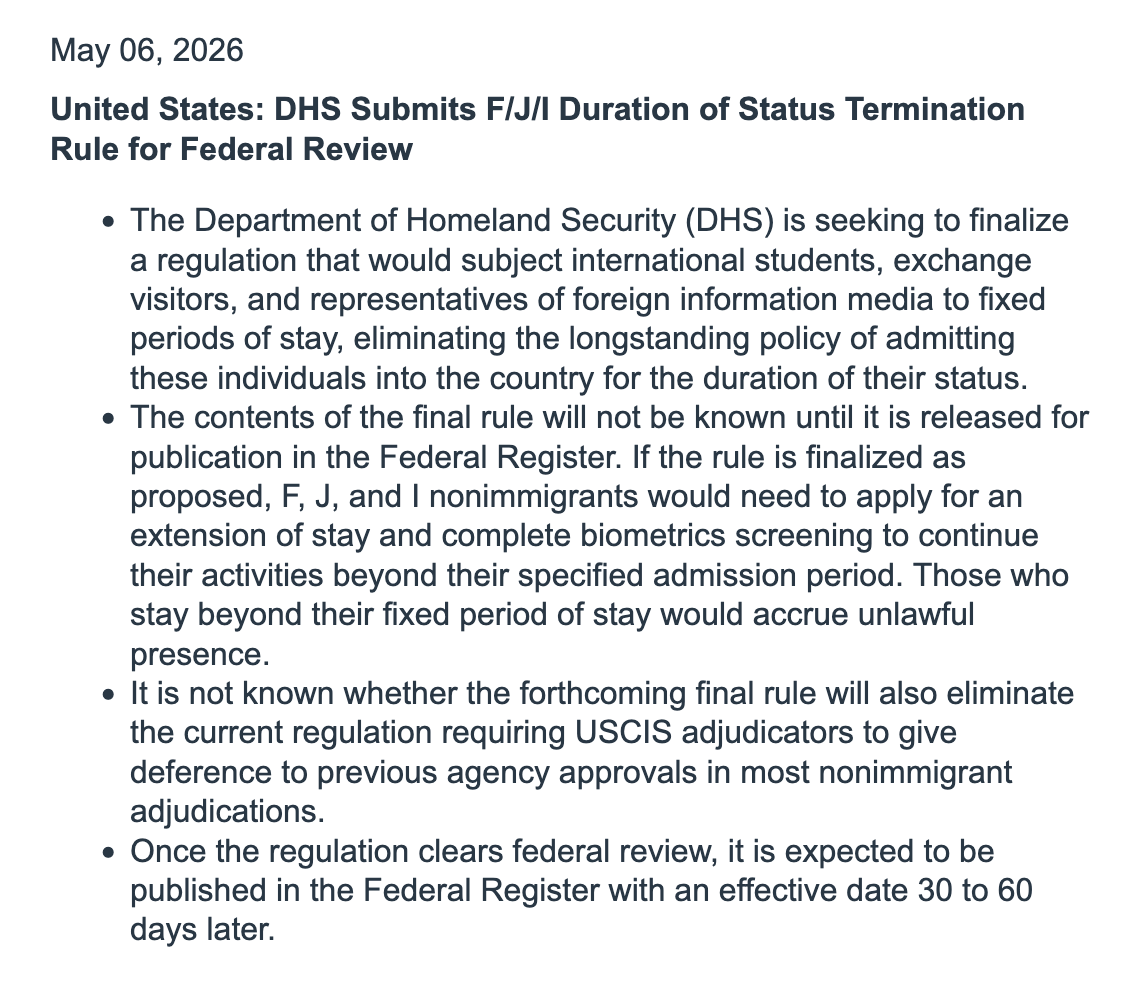
In fact, this is not a sudden new policy. As early as August 2025, the DHS and Immigration and Customs Enforcement (ICE) had already published the new regulations in the Federal Register: 'Establishing Fixed Admission Periods and Extension Procedures for Non-Immigrant Academic Students (F), Exchange Visitors (J), and Foreign Media Representatives (I)', eliminating the long-standing policy of entering the US under the “Duration of Status” (D/S).
Analysis of the August 2025 Draft
The new regulations may include the following aspects:
• The stay duration for F-1 students will be fixed, with a maximum of possibly no more than 4 years
• Academic extensions will no longer primarily be handled by the school’s DSO but may require submitting an extension application to immigration authorities
• The grace period after F-1 student graduation or OPT completion may be shortened from 60 days to 30 days
• Changing majors, transferring schools, or pursuing the same or lower-level courses may face more restrictions
• The application process for OPT and STEM OPT may become more complex
• If the fixed stay duration is exceeded without timely approval for an extension, the risk of unlawful presence may significantly increase
It is important to note that the final regulations have not yet been officially announced, and the specific content, implementation timeline, and whether they will affect current students remain subject to the final version. Worldway Group will stay updated and share any new information with everyone as soon as possible.
Why is this matter worth the attention of families planning to study abroad?
In the past, many families assumed the US identity pathway was: study abroad→OPT→H-1B lottery→green card. However, in recent years, the uncertainty of this pathway has continued to rise.
US immigration policy adjustments have been frequent, from H-1B lottery rules, OPT reviews, to F/J/I status duration management. The policy trends are constantly changing, making every step for international students in the US subject to stricter time limits and higher compliance pressures.
Of course, this does not mean studying in the US is not an option. The US still offers high-quality educational resources that remain attractive, but families planning to study abroad can no longer focus solely on school admissions or leave identity issues to be dealt with after graduation. For families with long-term plans to stay in the US, identity planning must be integrated with study planning and addressed early.
Identity planning should be prioritized early
In the context of increasing policy uncertainty, for families hoping for their children to develop long-term in the US, EB-5 investment immigration is a pathway worth focusing on. Unlike pathways relying on employer support or H-1B lottery, EB-5 is essentially an investment and job creation-based immigration category, not dependent on lottery results or employer sponsorship as application prerequisites.
Currently, under the new EB-5 law, there is a relatively favorable policy window. Among them, rural EB-5 projects enjoy no visa backlog and priority approval advantages; meanwhile, the “dual filing” policy allows eligible applicants to simultaneously submit I-526E and I-485 within the US, obtaining a Combo Card in about 3 months, thereby securing legal residency, work permits, and travel convenience as early as possible.
However, this window will not last long. As reserved visa quotas continue to be consumed, backlog pressure is gradually emerging; meanwhile, the grandfather clause will expire on September 30; and the minimum investment amount may increase on January 1, 2027. For families planning US identity, the earlier the evaluation, the better the chance to seize the current policy window.