The Wave of Layoffs Exposes Weaknesses in Staying in the U.S., EB-5 Becomes the Key to Residency!
An offer letter was once seen by many families as a ticket for their children to stay in the U.S.
However, a wave of layoffs can simultaneously affect jobs, visas, and future green card paths.
This is exactly the signal being sent by the U.S. job market in 2026: opportunities in the U.S. still exist, but the traditional path of "getting into big companies through education and obtaining residency through employer sponsorship" is becoming increasingly uncertain.
In the past, many families planned their children's development in the U.S. as a clear route: F-1 study → OPT internship → H-1B lottery → employer-sponsored green card.
But now, factors such as corporate layoffs, AI replacement, organizational restructuring, cost control, and hiring reductions are constantly disrupting this path. For international students, layoffs may affect not just a job but their entire residency status in the U.S.
1. A Set of Data to Understand What's Happening in the U.S. Job Market
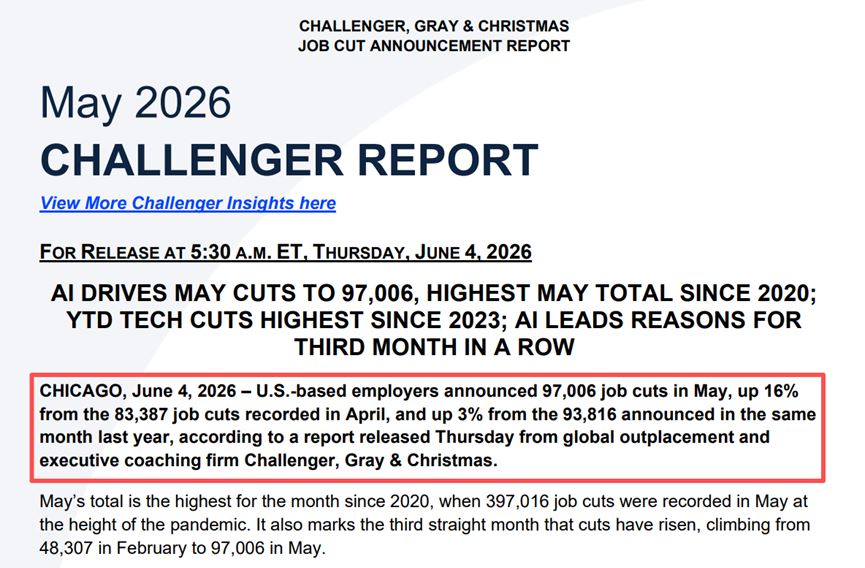
According to a career report released by a well-known career consulting firm: the total number of layoffs in the U.S. in May reached 97,006, a 16% increase from April's 83,387, marking the highest monthly record since May 2020.
The tech industry remains the focus of layoffs. In May 2026, the U.S. tech industry announced 38,242 layoffs; in the first five months of 2026, the tech industry cumulatively announced 123,653 layoffs, a 66% increase compared to the same period in 2025.
At the same time, U.S. corporate hiring plans are also shrinking. In the first five months of 2026, companies announced hiring plans for 80,472 people, with an average monthly hiring plan of only 16,094 people.
These data indicate that the U.S. job market is undergoing changes. Companies are still hiring, but they are more cautious, and job adjustments and organizational optimization are becoming the norm.
For families of international students, opportunities in the U.S. still exist, but the future requires more long-term planning rather than relying entirely on employers and the job market.
2. Big Companies No Longer Equal Stability, and Popular Majors No Longer Equal Security
In the past, many families of international students saw "getting into a big U.S. company" as a key step for their children's development in the U.S. As long as they entered tech companies, financial institutions, consulting firms, or large multinational corporations, it seemed they were one step closer to staying in the U.S. long-term.
But today, big companies can also lay off employees, popular industries can also undergo restructuring, and tech companies can also adjust teams for AI and automation.
Companies are not rejecting talent but are focusing more on job value, organizational efficiency, and long-term returns. For domestic job seekers in the U.S., this is career competition pressure; but for international students, there is an additional, more realistic issue: immigration status risk.
Because international students cannot stay just by finding a job. They also face multiple variables such as OPT deadlines, H-1B lottery, employer sponsorship willingness, job stability, and company hiring plans.
Once faced with layoffs, department adjustments, or company hiring reductions, the impact may not just be a job but the entire path to staying in the U.S.
This is the most direct reminder from the wave of layoffs in the U.S. to families of international students: The U.S. is not a place you can't go, but you can no longer bet your child's future entirely on employers and lotteries.
3. EB-5: A Path to Residency That Doesn't Depend on Employers
In this context, EB-5 investment immigration has always been one of the important paths for U.S. residency planning. Compared to the traditional path of staying in the U.S., EB-5 differs in that it does not rely on employer sponsorship or the H-1B lottery.
This is especially meaningful for families of international students:
• Studying solves the entry point for education;
• Working solves the starting point for a career;
• And EB-5 solves the foundation for long-term residency.
For families with children already studying in the U.S. or planning to study in the U.S. in the future, EB-5 is not a "remedial plan" to consider only after encountering immigration difficulties upon graduation but a proactive choice that can be incorporated into family planning in advance.
4. True Initiative Comes from Early Planning
The changes in the U.S. employment environment provide the biggest insight for families: not to change the direction of long-term planning but to plan for the U.S. earlier, more steadily, and more systematically.
For families of international students, future competition is not just about academic competition, professional competition, or job competition but also about the ability to plan for immigration status.
When H-1B lotteries, employer sponsorships, and the job market all have uncertainties, the significance of EB-5 is not just obtaining a U.S. green card but securing a proactive plan for the future for the family.
Currently, EB-5 rural projects are still in a critical phase where the no-queue policy advantage is prominent. According to the new legislation, rural projects enjoy exclusive reserved visa quotas, which are currently relatively sufficient, and are legally entitled to priority processing advantages.
It is worth noting that the "grandfather clause" protection period for the EB-5 new policy will expire on September 30, 2026. Applications submitted before this date will continue to be processed under the current legal rules even if future policies change.