Must-See for College Selection! New Global University Rankings Revealed
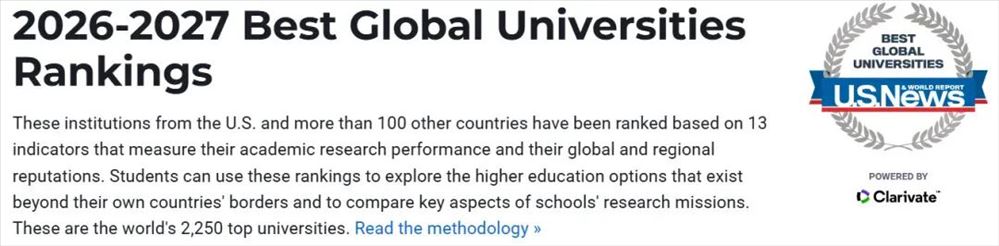
Recently, U.S. News released the highly anticipated 2026-2027 Global Best University Rankings.
The list covers 2,250 renowned universities from over 100 countries and regions. From the ranking results, American universities continue to maintain strong competitiveness, showcasing sustained influence in the global higher education landscape.
Outstanding Performance of American Universities
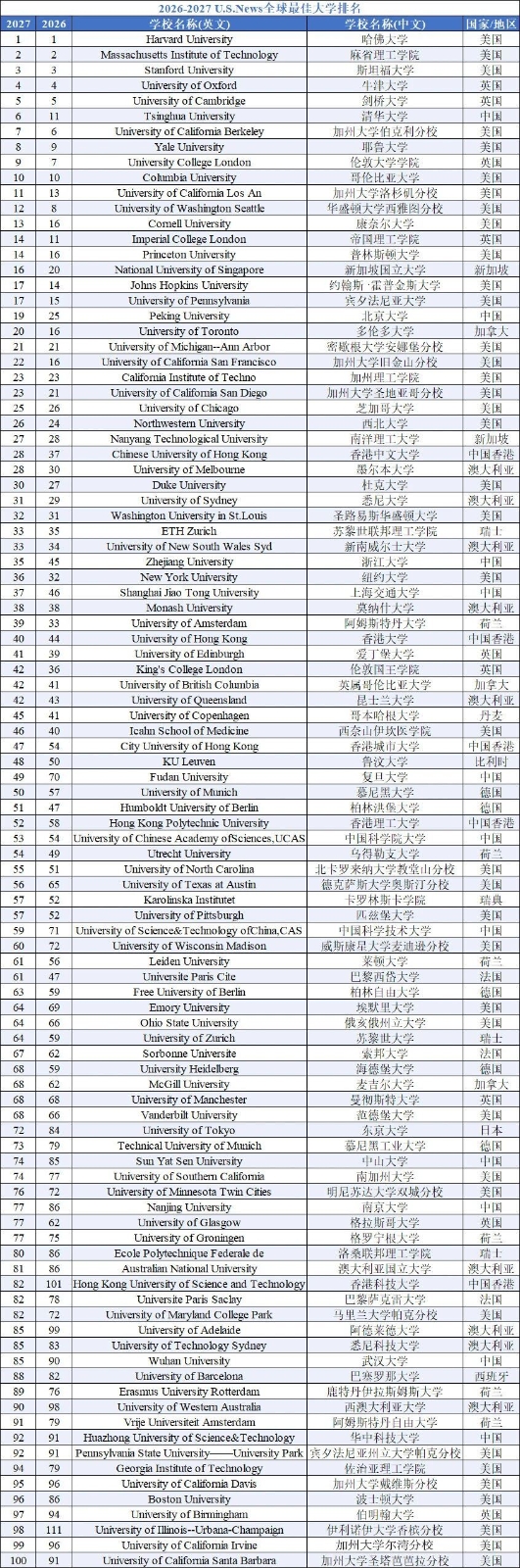
In this year's TOP10 list, American universities still dominate the top three spots, namely Harvard University, Massachusetts Institute of Technology, and Stanford University.
Not only is the leading advantage evident, but American universities also stand out in the overall hierarchy:
• Among the Top 10, American universities occupy 6 spots;
• Among the Top 50, American universities occupy 22 spots;
• Among the Top 100, American universities occupy 39 spots;
• Among the Top 200, the U.S. occupies 60 spots.
U.S. News Top 100 Rankings
Behind the Rankings:
What Makes American Education Attractive
The core evaluation criteria of the rankings include:
✔ Global Academic Reputation: 12.5%
✔ Regional Academic Reputation: 12.5%
✔ Publications: 12.5%
✔ Citation Quality: 10%
✔ Citation Volume: 10%
✔ High-Quality Paper Citations: 12.5%
✔ High-Quality Paper Citation Ratio: 10%
✔ International Collaborative Research: 10%
✔ Doctoral Degrees Awarded: 5%
✔ Professors with Doctoral Degrees: 5%
From the weight structure, it can be seen that indicators related to publications, citations, and research impact account for nearly 50%.
This means that the rankings measure not only the reputation of schools but also, to some extent, reflect the comprehensive performance of universities in research capabilities, knowledge creation, international influence, and talent cultivation.
The global attention American universities receive is also closely related to the advantages of their educational system.
On one hand, the U.S. boasts a diverse structure of higher education institutions. From comprehensive research universities to specialized colleges, and from foundational disciplines to cutting-edge interdisciplinary fields, it offers diverse choices for various development goals.
On the other hand, the value of American education is not only reflected in classrooms and rankings but also in the connections formed between education, research, industry, and career development. Students have opportunities to participate in research projects, industry practices, interdisciplinary collaborations, and international exchanges, accumulating more possibilities for future development.
For many families, choosing American education is essentially not just about selecting a school but preparing their children for a broader development environment.
Beyond Educational Planning
Identity Planning is Becoming a Priority
For an increasing number of families focusing on American education, admission is just the beginning. After entering university, how to reduce uncertainties and smoothly transition through studies, internships, and future development is becoming a new focus.
Especially in the current environment, many students still need to go through a series of uncertain processes after graduation, such as OPT, H-1B lottery, and work visa transitions. As a result, more families are beginning to realize that beyond educational planning, identity arrangements also need to be prepared in advance.
Instead of waiting until their children enter American universities to consider future development, it is better to incorporate identity factors into the overall plan earlier. By preparing in advance, families can leave more options open for future education, internships, employment, and long-term development.
Planning Ahead
Leaving More Options for the Future
Among the current U.S. identity planning paths, EB-5 has become one of the long-term planning methods of interest to many families. For families with clear American education planning needs, the value of EB-5 lies not only in the identity itself but also in providing more pathway options for future education, life, and long-term development, allowing families to make overall arrangements with a longer-term perspective.
Under the new EB-5 law, rural EB-5 projects are exempt from waiting periods and have priority approval advantages; the “dual filing” policy allows applicants in the U.S. to simultaneously submit I-526E and I-485, quickly obtaining Combo Cards and achieving legal residency and employment eligibility.
However, this advantage will not last indefinitely. As reserved quotas are gradually consumed, hidden waitlist warnings have quietly emerged; meanwhile, the grandfather clause will expire on September 30; and on January 1, 2027, the minimum investment amount may increase from $800,000 to $900,000-$937,500 or even higher. Therefore, for families with clear American education planning needs, completing assessments and planning in advance is more conducive to forming a long-term and stable development path.
Education is a long-term investment, and planning ahead is about leaving more possibilities for the future.