Sudden Shift in US Study Policy: 250,000 Students Facing Visa Status Test?
Another piece of heavyweight news has emerged regarding US study abroad policies.
According to reports, recently, US members of Congress sent a letter to the US Department of State, requesting the Trump administration to immediately suspend and cancel all F-1 student visas and J-1 exchange visitor visas held by Chinese citizens, and to stop issuing new student and exchange visitor visas to Chinese citizens.
According to statistics, if this proposal is adopted, it could affect more than 250,000 Chinese students currently studying at US universities.
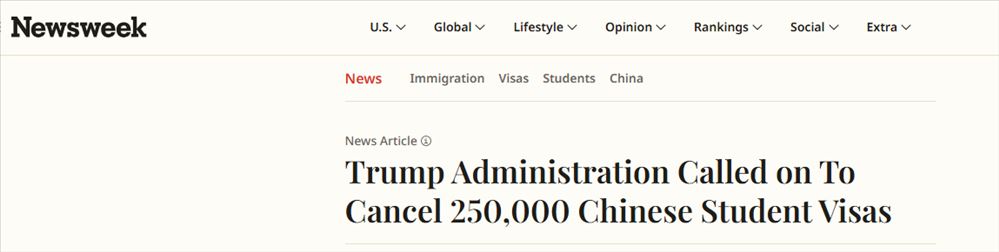
Currently, this is still only a policy proposal and has not been officially implemented. However, after the news broke, it still quickly triggered widespread concern among many Chinese students and parents.
Because for families planning for study abroad, what truly warrants vigilance is not just whether a specific policy is ultimately implemented, but that the visa status of Chinese students in the US is facing increasing uncertainty.
From Partial Scrutiny to Calls for Complete Cancellation, Risks in Study Abroad Policies Are Expanding
This is not the first time Chinese students have been affected by changes in US visa policies.
As early as May 2025, the US Department of State announced enhanced scrutiny of Chinese student visas and planned to revoke some of them. Since then, the US also temporarily suspended new student visa interview appointments and increased scrutiny of applicants' social media information.
The proposal put forward by the lawmakers this time further expands the scope, no longer limited to certain students or specific situations, but calling for the re-examination and cancellation of all F-1 and J-1 visas held by Chinese citizens.
From enhanced scrutiny to calls for complete cancellation, the challenges faced by Chinese students are becoming increasingly realistic:
Study eligibility, entry permits, and legal status in the US could all be affected by changes in the policy environment.
The Impact on Students Goes Beyond Whether They Can Continue Their Education
For many families, studying in the US is a long-term plan spanning several years.
From selecting schools and preparing applications, to paying tuition and arranging accommodation, to post-graduation internships, employment, and long-term development, the entire process requires a significant investment of time, energy, and capital.
However, F-1 is essentially a non-immigrant student status, and its validity is closely tied to policy requirements. Once visa scrutiny tightens, visas are revoked, or students are unable to enter normally, the impact may not just be on a single semester, but on the education and development plans of the entire family.
For students who have not yet traveled to the US, even if they have received admission and paid tuition, they may be forced to defer enrollment due to visa or entry issues.
For students already studying in the US, once they face visa revocation, entry/exit restrictions, or status scrutiny, subsequent transfer, further study, internship, and travel arrangements may also be affected.
More importantly, studying abroad is often just the first step in many families' plans for the US.
Many students also hope to gain work experience through OPT after graduation, then apply for H-1B, and ultimately seek employment-based immigration or other long-term pathways in the US. However, from F-1 to OPT, and then to H-1B, every step is influenced by policies, majors, employers, and lottery results.
A change in any single step could disrupt the original plan to stay in the US.
With Only a Student Status, It Is Hard to Hold Real Initiative
In the past, many families were accustomed to considering study abroad and immigration status planning separately.
During the study phase, the focus is on schools and majors; after graduation, they consider OPT, job hunting, and H-1B; once employment is stable, they apply for employment-based immigration through their employer.
This pathway seems logical, but the biggest issue is that every step is highly dependent on external conditions.
F-1 depends on the school and enrollment status, OPT is limited by major and unemployment duration, H-1B depends on the employer, position, and lottery results, and employment-based immigration may also be affected by company operations, visa backlogs, and policy adjustments.
Even if students have excellent academic performance and outstanding school backgrounds, they cannot fully control visa policies, lottery rules, and employer decisions.
This call to “cancel 250,000 Chinese student visas” serves as another reminder to study-abroad families:
Legally entering the US does not equate to having a long-term, stable US status.
For families who truly hope their children will study, work, and live in the US long-term, status planning should not wait until graduation, unemployment, or visa issues arise before starting.
From Relying on Schools and Employers to Establishing an Independent Status Pathway
Compared to F-1, OPT, and H-1B, EB-5 is a US employment-based immigration pathway based on family investment and job creation. Especially under the new EB-5 law, rural EB-5 projects have no backlog and enjoy priority processing advantages; the “concurrent filing” policy allows applicants with legal status in the US to file I-526E and I-485 simultaneously when there is no backlog, quickly obtaining a Combo card to achieve legal residency and employment authorization.
According to current policies, starting with an investment of $800,000, one person applies, and the whole family can quickly obtain a US Green Card. After obtaining a US Green Card, children will also have greater autonomy in education and career choices. In terms of school selection, they no longer need to maintain F-1 status to ensure legal stay; when looking for a job after graduation, they do not need to make “whether the company supports H-1B” the primary condition for filtering jobs; in the process of career development, they can also more freely change employers, adjust industries, or choose entrepreneurship.
Status gradually transforms from a constraint into a foundation that supports education and career development.
The $800,000 Window Is Entering a Critical Phase
It is worth reminding that starting January 1, 2027, the minimum EB-5 investment amount will undergo a new round of adjustment, and the $800,000 investment threshold will be raised to $900,000 to $950,000, or even higher.
This means that the current $800,000 application window has entered a critical phase with less than half a year remaining.