$100,000 for OPT? International Students Face Another Obstacle to Staying in the US
The cost for international students to stay and work in the US after graduation could see a significant increase.
According to The Wall Street Journal, the Trump administration is considering charging a fee of up to $100,000 for international students to work in the US after graduation through the Optional Practical Training (OPT) program.
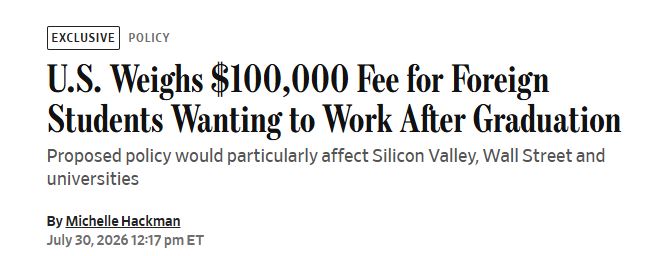
The $100,000 Threshold: Blocking the First Stop of Staying in the US After Graduation
OPT is a crucial channel for international students in the US to gain legal work experience after graduation.
Under current regulations, eligible F-1 international students can typically apply for an OPT work authorization of up to 12 months; graduates in STEM fields (Science, Technology, Engineering, and Mathematics) can also apply for an additional 24-month extension, allowing them to work in the US for up to 36 months.
For many international students, OPT is not just work experience, but a vital transition from student status to work status.
Currently, the conventional path taken by many international students is: studying abroad—OPT—H-1B work visa—employment-based green card.
According to data cited by The Wall Street Journal, approximately 419,000 foreign graduates worked in the US through OPT in 2024. For a long time, OPT has also been a key factor for the US to attract international students and global talent.
Once a $100,000 fee is added, both the cost and difficulty of this path to staying in the US will rise significantly.
Costs Increase Significantly: Both Students and Employers Will Re-evaluate
For international students who have just graduated and have not yet established a stable income, $100,000 is clearly not an ordinary application fee.
If the fee is borne by the students themselves, it is equivalent to adding a massive expense on top of several years of tuition, housing, and living costs. For average study-abroad families, this could directly alter their children's career choices after graduation, or even force some students to give up on working in the US.
If the fee is borne by employers, companies will also become much more cautious when hiring international graduates.
Especially for fresh graduates just entering the workforce, they usually have not accumulated irreplaceable work experience. When a company needs to bear an additional $100,000 cost for an OPT employee, they may prioritize local US job seekers who do not require visa sponsorship.
Therefore, once this policy is implemented, those affected will not only be international students, but also US universities that rely on international enrollment, as well as technology, finance, and engineering companies that heavily recruit international graduates.
More Alarming Than the $100,000 Fee is the Uncertainty of Temporary Status
For international students, the real risk is not just a sudden increase in fees, but the fact that the entire path to staying in the US after graduation is highly dependent on temporary status.
F-1 is a student status, OPT is a time-limited work authorization, and H-1B relies on employer sponsorship, job requirements, and visa caps. Even if students graduate from prestigious universities, major in popular fields, and successfully secure job offers, they still face challenges such as whether they can find employment in time, whether employers will support their applications, whether they can secure an H-1B cap slot, and whether the position can remain stable in the long term.
Academic credentials and capabilities determine whether one can secure a job opportunity, while legal status affects whether this job can be sustained stably.
“Studying abroad—OPT—H-1B—green card” seems like a complete path, but in reality, it requires passing through multiple policy and status hurdles in succession. If any single link changes, the entire family's plans for education, employment, and long-term stay in the US could be disrupted.
Plan Status in Advance to Gain the Initiative for Further Education and Employment
For families who clearly hope their children will study, work, and live in the US long-term, status planning should not wait until graduation, OPT expiration, or job search setbacks to be considered.
Compared to the OPT and H-1B paths that are highly dependent on employers, EB-5 investment immigration aims at obtaining US permanent residency, requiring no H-1B lottery and no reliance on a specific employer to maintain status.
Especially under the new EB-5 law, rural EB-5 projects have no visa backlog and enjoy priority processing; the "concurrent filing" policy allows applicants with legal status in the US to file I-526E and I-485 simultaneously when there is no backlog, quickly obtaining a Combo card to achieve legal residency and employment authorization. This means applicants' future educational and career choices can reduce reliance on OPT duration, H-1B lotteries, and single employers.
The $800,000 Window is Closing; Status Planning Should Be Done Sooner Rather Than Later
The current EB-5 policy dividends will not last forever. As reserved quotas continue to be consumed, the risk of a hidden backlog is emerging; on January 1, 2027, the minimum investment amount may also be raised from $800,000 to $900,000–$950,000 or even higher, and the grandfathering clause will expire on September 30.
For families with clear plans to stay in the US, the earlier the assessment, the better the chance to seize the current window. Rather than reacting passively when OPT tightens further, H-1B applications are blocked, or the EB-5 investment threshold is raised, it is better to seize the current $800,000 investment threshold and the grandfathering clause protection window to complete the assessment and start preparations as early as possible.