H-1B $100,000 Fee Suspended Again, Can We Stay in the US with Peace of Mind?
The high $100,000 H-1B fee has once again been put on hold by the court.
Recently, the U.S. Court of Appeals for the First Circuit rejected the Trump administration's emergency stay request, refusing to reinstate the $100,000 H-1B fee during the merits appeal.
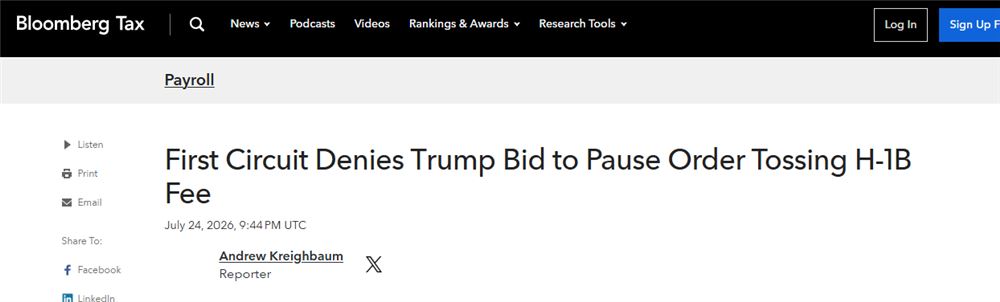
This means that the previous ruling by the U.S. District Court for the District of Massachusetts vacating the fee policy remains in effect. At this stage, relevant U.S. employers do not need to pay this $100,000 fee for the time being.
However, it is important to note that this ruling is not a final judgment on the merits, and the $100,000 fee cannot be simply understood as having been “permanently canceled.”
What happened from the introduction of the policy to its suspension once again?
• September 2025: The Trump administration, through a presidential proclamation, required certain individuals applying for H-1B visas from outside the United States through consular processing to pay an additional $100,000.
• December 2025: Twenty states, including California, Massachusetts, and New York, filed a lawsuit, arguing that this fee far exceeds normal visa processing costs and essentially constitutes a charge unauthorized by Congress.
• June 2026: The U.S. District Court for the District of Massachusetts ruled that the fee lacked clear congressional authorization and vacated the policy. The Trump administration subsequently appealed and applied to reinstate the fee during the appeal.
• July 2026: The First Circuit Court of Appeals rejected the government's emergency application. Therefore, before the merits appeal decision is announced, the $100,000 fee remains frozen.
However, this does not mean the policy has been permanently canceled. The merits appeal is still ongoing, and other courts have made different rulings on this matter; even if the original presidential proclamation expires, the government could still change its legal basis or policy format to reintroduce similar fee measures.
Therefore, more accurately, the $100,000 fee is only temporarily blocked by the court, and the H-1B policy battle is far from over.
Beyond the $100,000, the H-1B threshold is still rising
The $100,000 fee is only one link in the chain of H-1B policy changes. Even if this fee is eventually canceled, applicants still face multiple pressures.
Fierce competition for cap space. There are only 65,000 regular cap spaces and 20,000 advanced degree exemption spaces for H-1B each year. Facing competition from global applicants, supply and demand have been imbalanced for a long time, and the difficulty of being selected remains high.
Selection favors high-paying positions. The new mechanism links selection weight to wage levels, giving high-paying, high-level positions a greater advantage, while recent graduates and entry-level applicants face greater pressure.
Application scrutiny continues to tighten. Whether the position qualifies as a specialty occupation, whether the degree matches the job, whether the salary meets the requirements, and whether the employer-employee relationship is genuine may all become key areas of scrutiny.
Status is highly tied to the employer. H-1B requires employer sponsorship. In the event of layoffs, corporate restructuring, or difficulties in changing jobs, applicants must find a new employer or change status within a limited timeframe, which can directly affect their legal stay.
H-1B is always just a temporary work status. Even if successfully selected, it does not mean long-term security in the US. Subsequent applications for employment-based green cards usually still rely on the employer and may face complex processes and long backlogs.
Meanwhile, status management for F-category students and J-category exchange visitors is also tightening. The transition between studying, OPT, and H-1B places higher demands on application timing and status compliance.
From the $100,000 fee and wage-weighted selection to adjustments in scrutiny standards and international student status management, H-1B is moving toward “high-salary priority, stricter scrutiny, and lower tolerance for error.” For applicants, what truly needs vigilance is the uncertainty brought by long-term reliance on lottery results, employer sponsorship, and policy trends.
Plan green card pathways early to increase status initiative
The court ruling may have bought some breathing room for H-1B applicants. However, it only resolves a temporarily frozen fee and does not change the overall trend of continuous tightening of temporary work and international student status in the US.
For families who hope their children will receive education, work, and develop long-term in the US, planning green card status in advance can allow children to avoid relying entirely on F-1, OPT, H-1B, or a single employer when choosing schools, majors, internships, and career directions in the future.
Among various green card pathways, EB-5 investment immigration is highly popular. With the implementation of the new EB-5 law, its two major advantages have drawn attention: first, the no-backlog opportunity brought by reserved visas; second, the "concurrent filing" policy, which allows applicants who are in the US with legal status and face no backlog to file I-526E and I-485 simultaneously, quickly obtaining a Combo Card to achieve legal residence and work authorization.
It is worth noting that currently, EB-5 is facing a double countdown of "investment amount increase" and "grandfathering clause expiration." On January 1, 2027, the minimum EB-5 investment amount will increase from $800,000 to $900,000-$950,000 or even higher, and the grandfathering clause will expire on September 30, 2026.