USCIS New Rule: Incomplete Applications May Be Directly Denied
The review rules for U.S. immigration applications are undergoing a major adjustment.
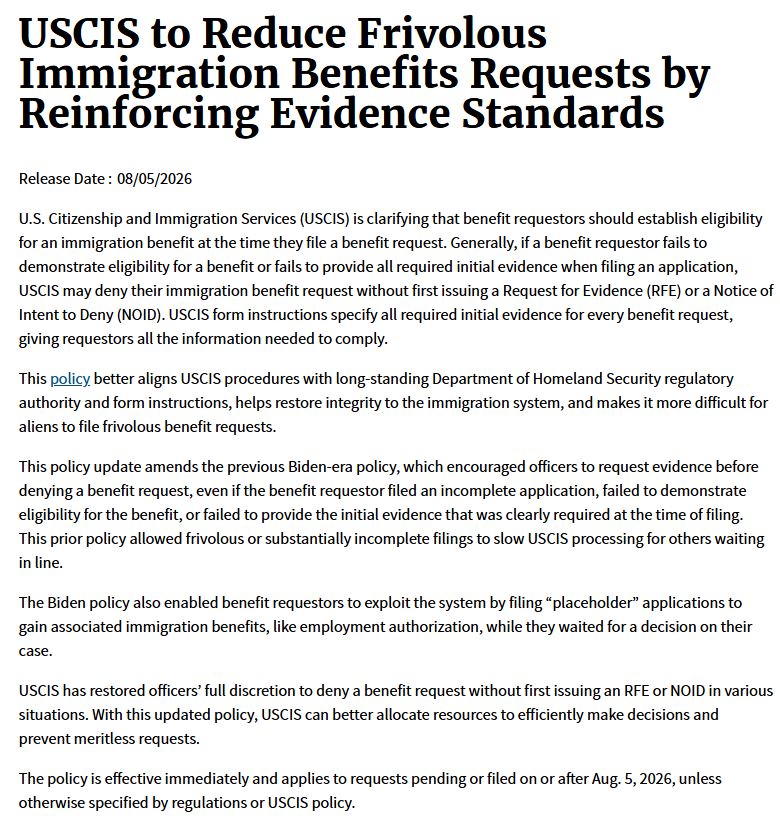
On August 5, 2026, local time, the U.S. Citizenship and Immigration Services (USCIS) released a policy alert titled "Evidence, Requests for Evidence, and Notices of Intent to Deny," further strengthening the evidentiary review standards for immigration applications.
The new rule clarifies: the practice of issuing an RFE (Request for Evidence) or a NOID (Notice of Intent to Deny) first when materials are incomplete is abolished. Applicants must submit a complete and compliant set of initial evidence at the time of filing. If an application lacks a legal basis for approval, or if initial materials are missing/insufficient, immigration officers can directly deny the case without reserving an opportunity for rebuttal or supplementation.
The new rule takes effect immediately upon publication and applies to cases still pending on August 5, 2026, as well as all new applications submitted on or after that date.
Initial Submission Becomes Crucial; RFE is No Longer a Guaranteed Remedy
This policy adjustment sends a very clear signal: U.S. immigration applications now demand higher standards for the completeness and evidentiary quality of the initial submission.
In the past, many applicants were accustomed to "submitting the application first and supplementing missing materials after receiving an RFE," or even believed that as long as basic requirements were met, gaps in initial materials would not directly affect the progress of the case.
However, under the new rule, the risk of this approach has risen significantly. USCIS has reiterated that applicants should submit the required initial evidence at the time of filing to fully demonstrate eligibility, and continue to meet relevant requirements throughout the adjudication process. If the applicant fails to meet the burden of proof, the immigration officer can directly issue a denial.
Simply put, U.S. immigration applications are shifting further from the past "submit first, perfect later" approach to "initial submission must be complete and sufficient." Applicants can no longer view RFEs or NOIDs as guaranteed opportunities for remedy. Whether materials are complete, evidence is sufficient, and the overall logic is clear will directly impact whether the case can proceed smoothly.
Response Times for RFEs and NOIDs Tightened Simultaneously
At the same time, the new rule adjusts the response deadlines for RFEs and NOIDs. Previously, when USCIS issued an RFE or NOID to an applicant outside the U.S., a 14-day mailing buffer was typically added. Under the new rule, this arrangement is eliminated. Going forward, the response deadline for an RFE will be determined by the immigration officer based on the case circumstances, up to a maximum of 12 weeks; the response deadline for a NOID will not exceed 30 days, and for those delivered by mail, typically only an additional 3 days will be added.
This means that not only is the margin for error in the initial submission shrinking, but the time to respond after receiving an RFE or NOID is also becoming tighter.
Under the New Rule, Documentation Quality is Even More Critical
As everyone knows, for EB-5 immigrant investor applications, the documentation is not only voluminous but also highly complex.
The "documentation" in an immigration application is not just about filling out forms or organizing files. Rather, it involves organizing a complete, clear, and verifiable system of evidence based on the client's actual situation, source of funds, path of funds, and underlying supporting documents, in accordance with legal requirements.
Under the new rule, whether the documentation is complete and rigorous is no longer just a matter of processing speed; it may directly affect whether the application can smoothly proceed to subsequent review, and whether there is still room for further supplementation and explanation.
Years of Documentation Experience: Worldway Helps Safeguard Application Quality
For a long time, Worldway has always regarded documentation quality as an important foundation of its EB-5 services. As one of Asia's 500 Most Influential Brands, Worldway Group has been deeply involved in the investment immigration field for over 20 years. It boasts an experienced professional documentation team capable of systematically organizing application materials based on clients' actual situations, ensuring that application documents comply with U.S. immigration regulations and review requirements.
On this basis, Worldway has partnered with two renowned U.S. law firms, Greenberg Traurig (GT) and Miller Mayer, to establish a collaborative mechanism of "professional documentation team + U.S. legal team." Through this powerful alliance, we aim to identify and resolve material gaps and potential issues before submission as much as possible. This ensures that every application, upon its initial submission, possesses clear factual logic, sufficient evidentiary support, and a professional legal basis, providing multiple layers of quality control for clients' EB-5 applications.
New Rule Coupled with Price Hikes and "930": EB-5 Enters a Critical Sprint Phase
This adjustment of evidentiary review rules comes at a time when key EB-5 windows are rapidly tightening.
According to current policy arrangements, starting January 1, 2027, the minimum EB-5 investment amount is expected to be adjusted from the current $800,000 to $900,000 or $950,000, or even higher. Meanwhile, September 30, 2026, is an important milestone for the "grandfathering clause" under the new EB-5 law.
This means that families intending to plan their U.S. status through EB-5 must seize both the "930" policy window and the current $800,000 investment threshold.