Immigrating for Education? The New 2027 Global University Rankings Provide the Answer
For many families, the appeal of studying in the United States has never been just about a prestigious degree.
From world-leading university resources and a mature scientific research system to an employment environment closely connected with industries such as technology, finance, and healthcare, the US remains a key destination for global higher education. The newly released 2027 QS World University Rankings once again confirm the comprehensive strength of American higher education.
Double Leadership in Prestigious Universities and Overall Scale for US Institutions
The 2027 QS World University Rankings, released by the international higher education research agency QS Quacquarelli Symonds, cover over 1,500 universities across 106 countries and regions globally.
Among the global top 10, US universities occupy 4 spots: Massachusetts Institute of Technology (MIT) ranks 1st globally for the 15th consecutive year; Stanford University rose from 3rd place last year to 2nd; Harvard University ranks 5th; and California Institute of Technology (Caltech) rose from 10th to 7th.
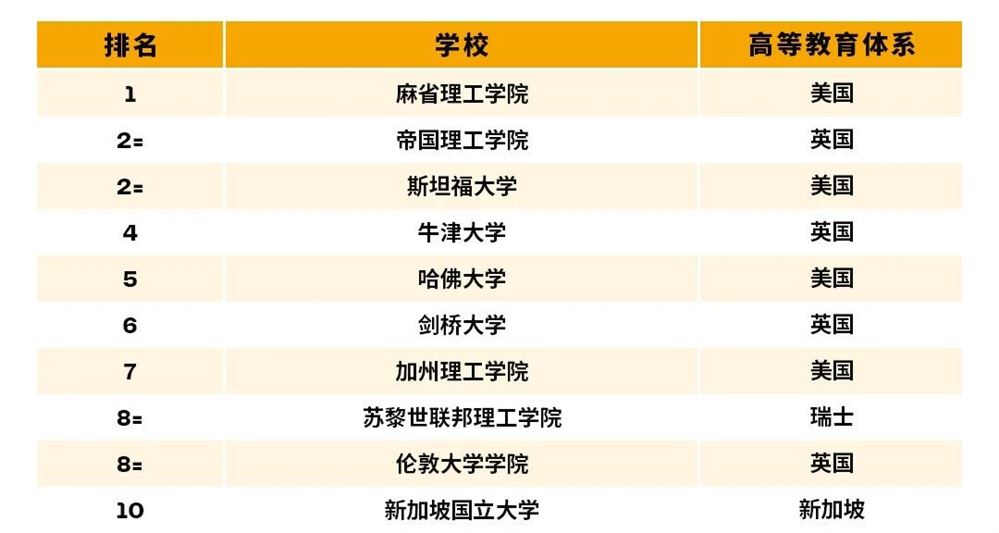
Among the global top 20, the advantage of US universities is equally obvious. The University of Pennsylvania ranks 15th, Cornell University and Yale University are tied for 16th, and Johns Hopkins University is tied with the University of California, Berkeley for 20th. A total of 9 US universities have entered this tier, occupying nearly half of the global top 20 spots.
The advantage of US universities is reflected not only in the leading performance of top-tier institutions but also in the breadth of overall educational resources. In this ranking, a total of 184 US universities are listed, with 26 entering the global TOP 100 and 42 entering the global TOP 500, forming a multi-tiered education system composed of private universities, public research universities, and specialized institutions, providing rich choices for students of different backgrounds and development directions.
Multi-dimensional Evaluation System Showcases the Comprehensive Strength of US Universities
The 2027 QS World University Rankings do not just compare the popularity of universities, but comprehensively evaluate institutions in terms of research strength, graduate employment, internationalization, teaching experience, and sustainable development.
Among these, Research and Discovery accounts for 50%, including Academic Reputation and Citations per Faculty; Employability and Outcomes accounts for 20%, including Employer Reputation and Employment Outcomes; Global Engagement accounts for 15%; Learning Experience accounts for 10%; and Sustainability accounts for 5%.
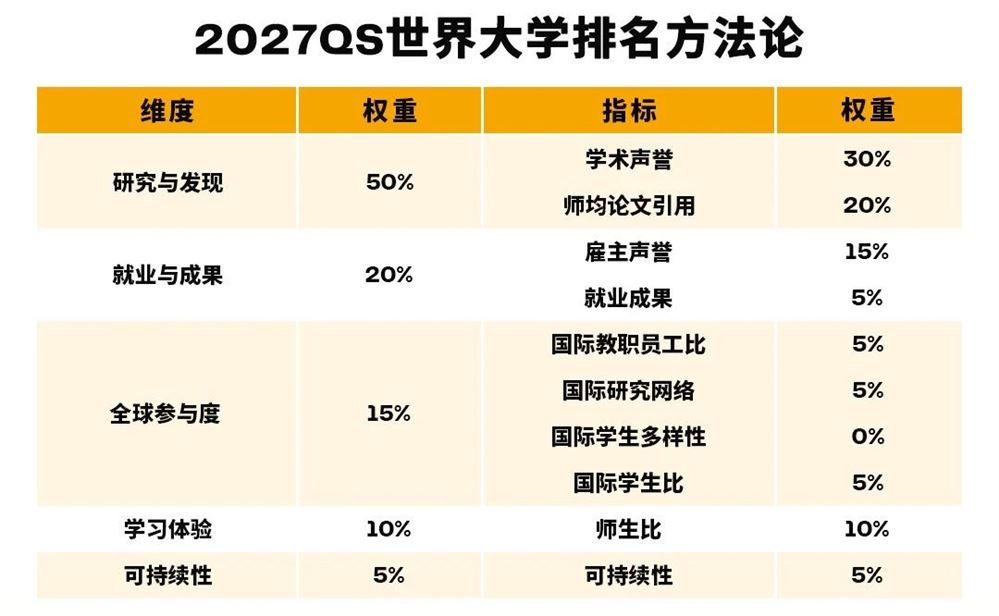
This means that for a university to enter the global top tier, it must not only have deep academic accumulation but also maintain long-term advantages in scientific research achievements, talent cultivation, graduate development, and international resource connections.
The ability of US universities to continuously occupy the top of the list is backed by a mature educational system, a strong scientific research foundation, and a close collaborative relationship between universities and industries.
From Classroom to Industry, US Education Connects to More Development Opportunities
The advantages of US education are not only reflected in university rankings.
For a long time, US universities have maintained close ties with scientific research institutions, technology enterprises, medical institutions, financial centers, and innovative industries. While receiving classroom education, students also have opportunities to participate in laboratory research, corporate internships, innovation and entrepreneurship, and interdisciplinary projects.
Especially in fields such as artificial intelligence, computer science, engineering, biomedicine, finance, and business management, the US concentrates a large number of world-leading universities, enterprises, and scientific research platforms.
This innovative ecosystem, composed of education, scientific research, industry, and capital, allows international students to obtain not just a learning experience, but also opportunities to access cutting-edge technologies, expand international horizons, and accumulate professional resources.
The "Open Doors 2025" report released by the Institute of International Education (IIE) shows that in the 2024–2025 academic year, US universities attracted a total of 1,177,766 international students, accounting for 6% of the total number of higher education students in the US, with 57% of international students choosing STEM-related majors.
From university resources to scientific research platforms, and then to career development after graduation, the US remains an important destination for global students to receive higher education and explore future opportunities.
After Admission to Prestigious Universities, the Status Issue is Equally Critical
For families planning to send their children to study in the US, choosing schools, majors, and preparing applications are certainly important, but these mainly solve the question of "where to study."
Whether children can smoothly intern, find employment, and continue to develop in the US after graduation also depends on immigration status arrangements.
Most international students study in the US under F-1 student status. After graduation, eligible students can apply for OPT to engage in temporary work related to their major; STEM graduates may also apply for an extension.
But both F-1 and OPT have clear status requirements and time limits. From studying in school to graduation internships, and then to subsequent work status, international students also need to face multiple factors such as employment deadlines, major matching, employer support, and policy changes.
Therefore, for families planning to let their children study and develop in the US for the long term, educational planning and status planning need to be considered simultaneously.
A stable status foundation is not only related to whether children can continue to stay in the US, but also affects their freedom to choose schools, majors, internships, and jobs in the future.
Simultaneous Layout of Education and Status, Seizing the Critical EB-5 Window
EB-5 provides studying families with an immigration pathway that does not rely on schools or specific employers, so that children's future development does not have to rely entirely on F-1, OPT, or a single employer, giving them more initiative in choosing further education, internships, and employment.
Currently, rural EB-5 projects have the advantages of no visa backlog and priority processing. The "concurrent filing" policy allows applicants who have legal status in the US to file both I-526E and I-485 simultaneously when there is no backlog, and apply for work authorization and travel documents.
It is worth noting that the current minimum investment amount for EB-5 will be adjusted on January 1, 2027, and the $800,000 investment threshold will be raised to $900,000 to $950,000, or even higher; meanwhile, the grandfathering clause will also expire on September 30, 2026.