Alert! New Barriers Being Added for Studying in the US
This fall, US universities have taken another step forward in auditing international students.
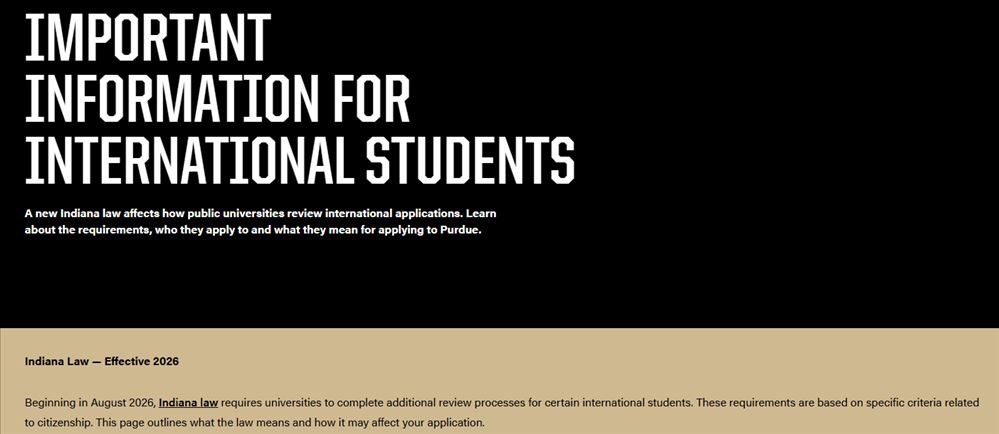
Worldway Immigration has noticed that Purdue University, a well-known and prestigious science and engineering institution in the US, has officially launched a new research security review.According to Indiana Senate Bill SB256, some international students and postdocs from specific countries, including China, who apply for related majors, must pass an additional research security review before receiving formal admission or employment.
This new regulation officially took effect on August 15, 2026.
Put simply, while many security reviews previously occurred after visas, research projects, or entering laboratories, this review has now been moved further forward to the university admission stage.
I. Which Chinese studentswill be affected?
This new regulation is not targeted at all international students, nor will all Chinese students applying to Purdue undergo additional screening.
According to the information currently released by Purdue University, it mainly involves international applicants from specific countries, including China, who apply for related majors.
The majors currently explicitly included in the scope are:
Chemical Engineering, Electrical Engineering, Industrial Engineering, Mechanical Engineering, Artificial Intelligence, Computer Science, Microbiology and Virology, etc.
Undergraduate, master's, doctoral, and some postdoctoral applications may all be involved.
However, if the applicant already holds US citizenship, a US green card, or meets relevant asylum status conditions, they are not within the scope of this review.
Therefore, this policy is not “Purdue will no longer recruit Chinese students,” but rather that some Chinese applicants will have an additional review on top of the original application process.
II. Besides Grades and Research,
What Else Will Be Checked?
This newly added review does not just focus on how good the student's grades are or whether their research experience is sufficient.
Applicants may also need to supplement information regarding their education and work history, research collaborations, external funding sources, and past connections with relevant institutions.
If the materials are complex, the university may also request further clarification.
For applicants, the most direct impact is: more materials to prepare, and the review time may also become longer.
In the past, when applying to US universities, everyone focused more on GPA, language scores, research, internships, and essays; in the future, for applicants of some sensitive majors, they will also need to reserve time for research security reviews.
Therefore, for students preparing to apply to US universities, they need to reserve more ample preparation space in school selection and application scheduling.
III. Why Is Purdue's Change This Time
Worthy of Attention?
On one hand, it is because Purdue University itself is a prestigious US science and engineering institution that Chinese students pay close attention to.
Engineering, computer science, and artificial intelligence majors have always been popular directions for Chinese students to apply for, and these majors happen to overlap highly with this newly added review.
On the other hand, what is more worthy of attention is the direction behind the policy changes.
In recent years, US scrutiny of university research security, international research collaboration, sensitive technologies, and foreign funding sources has been continuously strengthening.
In the past, these requirements seemed to be at a certain distance from ordinary international students.
But this time, Indiana has directly placed part of the review before admission, meaning that research security management is extending further to the front end of study abroad applications.
Worldway Immigration believes that for families planning US education, what truly needs attention regarding these changes is that studying in the US is adding more and more policy variables beyond academic performance.
IV. Studying in the US
Cannot Just Be About Preparing an Admission Letter
Worldway reminds that for families with long-term plans to go to the US, what truly needs to be considered is not just whether they can successfully get admission.
If you hope your child will continue to intern, work, or even develop long-term in the US after graduation, then from university admission to F-1 student status, to OPT, and H-1B, every subsequent stage cannot bypass the status issue.
Studying abroad solves the problem of entering a US campus, while status affects how many choices there will be in the future.
This is also why more and more families with long-term plans to go to the US are considering education and status together.
An Asian Brand 500 company, Worldway Group, which has focused on immigration for over 20 years, started in Hong Kong in 1998 and has been rooted in Hong Kong for over 20 years, with professional companies in both Hong Kong and Mainland China. Based on long-term experience in serving US immigrant families, Worldway Immigration also continuously monitors the changes between study abroad policies and long-term status planning.
Taking EB-5 Investment Immigration as an example, under the new law, rural projects still enjoy policy advantages such as reserved visa quotas and priority processing; for applicants who meet the conditions and maintain legal status in the US, they can also concurrently file "double submission" to advance status adjustment when there is no visa backlog.
For families who have already made it clear that they want their children to study, work, and develop in the US for the long term, rather than waiting until graduation, job hunting, or even visa changes to handle status issues, it is better to put the educational path and long-term status planning on the same timeline earlier.
And right now, EB-5 is also in a time window worthy of attention. Currently, the minimum investment for EB-5 is still $800,000. Starting January 1, 2027, the investment amount will be increased to $900,000 - $950,000 or even higher. At the same time, the September 30, 2026 grandfather clause deadline is also approaching.