Heavy Blow! US Birthright Citizenship Tightened Further
The U.S. government is further tightening its definition of the scope of birthright citizenship.
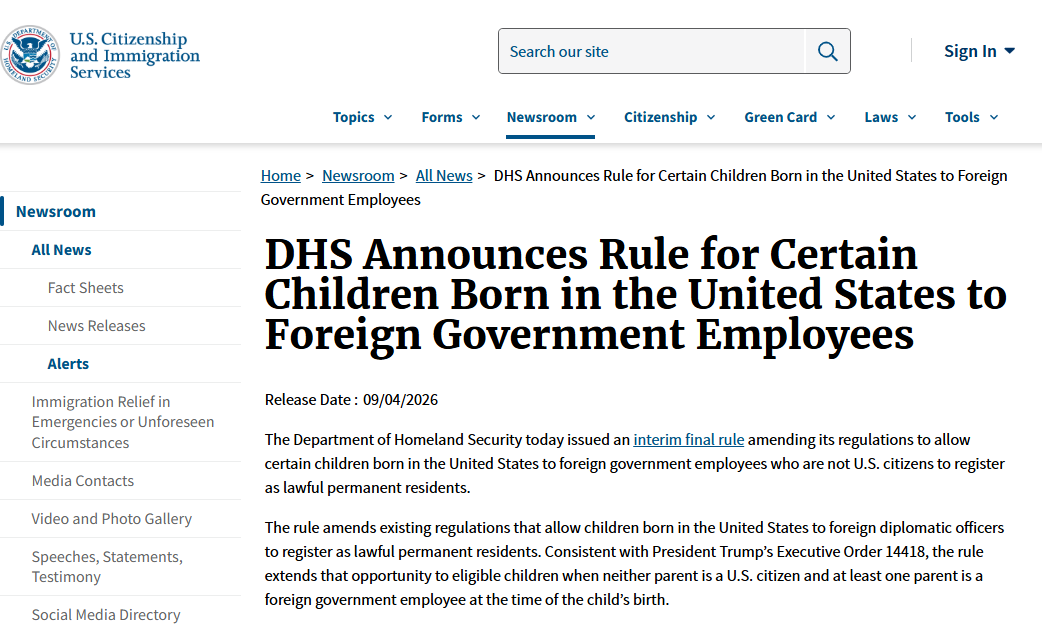
On September 4, local time, the U.S. Department of Homeland Security (DHS) issued a temporary final rule, establishing new regulations for the status determination of children born in the United States to certain foreign government employees.
Worldway Immigration has noted that under the new DHS rule, if neither parent is a U.S. citizen at the time of the child's birth, and at least one parent is a “foreign government employee” as defined by the rule, the child may not automatically acquire U.S. citizenship by birth in the United States. Meanwhile, eligible children can apply to register as U.S. permanent residents.
I. What are the key changes in this adjustment?
In the past, U.S. birthright citizenship itself had a few exceptions.
The Fourteenth Amendment to the U.S. Constitution provides that persons born in the United States and “subject to the jurisdiction thereof” acquire U.S. citizenship in principle, but children born in the U.S. to foreign diplomats have long been a classic exception because their parents possess special diplomatic status and immunity.
The biggest change in this rule is that it further expands this scope from “foreign diplomats” in the traditional sense to certain foreign government and international organization employees. According to the DHS definition, the relevant personnel mainly include:
• Foreign diplomats accredited to the United States;
• Employees of foreign embassies or consulates in the United States who are nationals of that foreign country;
• Persons employed by a foreign government in an official capacity;
• Persons employed by international organizations that enjoy relevant immunities.
II. No automatic citizenship, but eligible individuals can register for a Green Card
There is another important arrangement in this new rule.
For children who cannot automatically acquire U.S. citizenship due to the aforementioned regulations, the U.S. government has simultaneously provided a pathway for permanent resident registration.
Eligible applicants can apply to register as U.S. permanent residents using Form I-485, and DHS has also adjusted the relevant application rules and forms accordingly.
According to the regulations, applicants must meet corresponding conditions, including being born in the United States, neither parent being a U.S. citizen at birth, at least one parent being a foreign government employee within the specified scope, and continuously maintaining a residence in the United States, among others.
If the child enjoys diplomatic privileges or immunities, they must also waive such privileges and immunities in accordance with regulations before their permanent resident status officially takes effect.
Simply put, for children affected by the new rule, the status pathway may change from “acquiring U.S. citizenship at birth” to “no automatic citizenship, but eligible to register as a permanent resident.”
It is important to note that this new rule is currently still affected by litigation. On September 2, the U.S. District Court for the District of Maryland issued a preliminary injunction in a related case, so DHS will not currently take measures that conflict with the court's ruling against the population protected by the injunction. The extent to which the new rule will be implemented in the future still depends on the further development of the judicial process.
III. Scrutiny of birthright citizenship continues to tighten
If we look at this new rule in the context of a recent series of policy changes, the U.S. government's direction toward tightening birthright citizenship has become increasingly clear.
Although this new rule only targets specific groups, from previous executive orders on birthright citizenship to restrictive measures against “birth tourism,” and now to DHS further detailing the relevant application rules, the U.S. government's scrutiny and application standards regarding “who can acquire citizenship by birth in the United States” are continuously becoming stricter.
Although some measures still face judicial challenges, for families with plans for education, living, and long-term development in the U.S., one trend is worth noting:
The room for obtaining status certainty through a child's place of birth is shrinking, and whether the parents themselves possess a stable, long-term U.S. status has also become more important.
Compared to visas, temporary status, and status pathways easily affected by policy changes, planning a long-term status in advance can give families greater initiative in their children's education, living in the U.S., and career development.
Currently, for families wishing to obtain long-term U.S. status through investment, EB-5 remains one of the pathways worthy of key attention.
Currently, under the new law, rural EB-5 projects still enjoy reserved visa quotas and priority processing; for eligible applicants who are in the U.S. and maintaining legal status, they can also concurrently advance their adjustment of status through “concurrent filing” when there is no visa backlog.
At the same time, EB-5 is also approaching two important milestones: the September 30, 2026 grandfathering clause milestone, and the January 1, 2027 investment amount adjustment milestone.
For families who already have clear long-term plans for the U.S., rather than pinning their hopes for status on whether future policies will be relaxed, it is better to combine their own circumstances as early as possible to establish a more stable and controllable status plan in advance.