PERM Suspension Wave: H-1B Path to Staying in the US Blocked!
A tech giant with over 350,000 employees and a long history of heavy H-1B (specialty occupation visa) usage has suddenly had a key step in its green card application process paused.
Worldway Immigration noted that on September 9, 2026, local time, according to relevant media reports, the US government has suspended the submission of new PERM (Permanent Labor Certification) applications by Cognizant, a large IT services company. Meanwhile, federal departments are investigating suspected fraud in the company's H-1B and PERM programs.
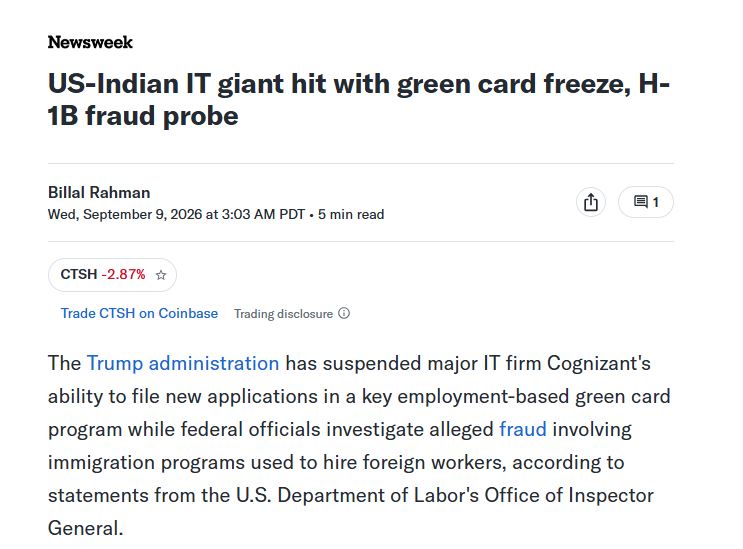
And this news was actually personally confirmed a day earlier by the Inspector General of the US Department of Labor.
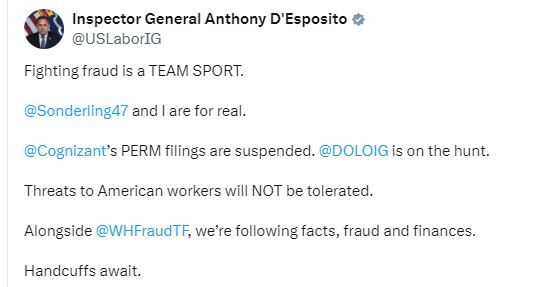
On September 8, Anthony D'Esposito, the Inspector General of the US Department of Labor, stated on his official social media account that Cognizant's PERM applications have been suspended, and the Office of Inspector General of the US Department of Labor is conducting an investigation.
He also revealed that the investigation involves the H-1B and PERM programs and is being advanced in coordination with the White House Task Force on Fraud, among others. His public stance was quite tough: “Any behavior that threatens the rights and interests of American workers will not be tolerated.”
For many foreign nationals working in the US long-term, PERM is directly related to whether the subsequent green card application can be smoothly initiated. Once a problem arises on the employer's side, even if the employee's own work and status are completely normal, the green card arrangements originally progressing as planned may suddenly face variables.
I. A Major H-1B User Under Investigation
Why is this drawing so much attention?
Cognizant is not an ordinary company.
As of the end of 2025, the company had approximately 351,600 employees globally, with about 256,900 located in India, making it one of the world's largest IT consulting and outsourcing services enterprises.
It is also a major user of US H-1B visas. In recent years, the number of H-1B approvals for Cognizant has increased significantly: an annual average of over 2,500 approved from FY 2022 to 2024; and as of June 30 in FY 2026, 3,510 H-1B applications have already been approved.
For many foreign employees, after obtaining an H-1B, the next step is often waiting for the company to initiate PERM to continue preparing for a long-term stay in the US.
PERM has a very important characteristic: it must be applied for by the employer. The company must complete the recruitment process according to regulations and prove that there are no qualified US workers available to fill the relevant position.
This also means that an employee's green card progress is largely influenced by the employer. Whether the company is willing to initiate the process, whether the recruitment procedures are compliant, and whether the company itself is under investigation can all directly affect the application progress.
Therefore, what the Cognizant incident truly reminds those working in the US is:
When your long-term status depends on your employer, changes in the company can also directly affect your personal status planning.
II. Not Just Cognizant
The US is expanding audits on companies
Looking back, Cognizant is not an isolated case.
In May of this year, the US Department of Labor took action against tech company Cloudera, suspending the processing of all its PERM applications for 180 days. At that time, the US government believed there might be issues with some of the company's recruitment procedures, including whether qualified US workers actually received a fair opportunity to apply for the relevant positions.
And in July of this year, the Office of Inspector General of the US Department of Labor announced an intensification of investigations into potential fraud in the H-1B and PERM programs. The focus of the investigation includes fraudulent applications, wage issues, non-compliant use of foreign labor, and non-compliant behaviors by some companies and labor agencies. (Click to read Worldway's previous report: Another Obstacle on the Path to the US! H-1B/PERM Strict Audits Escalate)
By August, the Inspector General of the Department of Labor also traveled to Dallas, Texas, to conduct on-site inspections of some corporate addresses involved in a large number of H-1B applications. Among them, some office addresses were associated with over 500 approved H-1B applications, yet almost no signs of normal business operations were visible on-site.
In addition, the "Project Firewall" (“Project Firewall”) launched by the US Department of Labor in 2025 continues to strengthen supervision over H-1B employers. Official data shows that nearly 200 companies suspected of abusing the H-1B program have been investigated.
From Cloudera to Cognizant, an increasingly clear trend can be seen: US regulation of H-1B and PERM is extending from the applicant to the employer side. Whether the company is operating genuinely, and whether the positions and recruitment procedures are compliant, are all becoming key focuses of scrutiny.
III. H-1B Rules Are Also Changing
More and More Variables to Staying in the US
While employer-side regulation is tightening, H-1B itself is also undergoing changes.
Starting from FY 2027, H-1B has implemented a new wage-weighted selection mechanism, giving higher weight to applicants in higher wage levels. For international students who have just graduated and have relatively lower wage levels, it will be even harder to win the H-1B lottery in the future.
In August of this year, the US Department of Homeland Security also proposed a new fee structure, planning to levy an additional fee of $103,265 for certain H-1B applications subject to the annual cap.
Meanwhile, the 60-day grace period for H-1B holders after losing their jobs is also facing adjustments.
Looking at these changes together, it becomes clear that H-1B faces new changes and uncertainties in everything from lottery rules, employer audits, and labor costs, to the status buffer period after unemployment.
V. Long-term Stay in the US
Status Planning Needs to Be More Proactive
H-1B and PERM remain important pathways for many people to work and develop long-term in the US.
But if you have already decided that you want to stay in the US long-term, it is necessary to consider another layer: must your long-term status rely solely on a single employer?
In contrast, the new EB-5 investor visa does not require employer sponsorship, nor does it participate in the H-1B lottery. For eligible applicants currently in the US, when visa numbers are available and other conditions are met, they can concurrently file the I-526E immigrant petition and the I-485 adjustment of status application, allowing their work and long-term status to progress independently.
Currently, the three reserved visa categories under the new EB-5 law are still in a "no backlog" window, and two important deadlines are approaching: on September 30, 2026, the grandfathering clause faces a critical milestone; starting January 1, 2027, the minimum EB-5 investment is expected to increase from $800,000 to $900,000-$950,000 or even higher.
For families who already have clear long-term plans to move to the US, rather than waiting to consider status issues after changing jobs, layoffs, company PERM suspensions, or policy changes, it is better to understand the different pathways in advance to keep more options open for the future.