99.2% are H-1B! The US Unemployment Grace Period is About to End
H-1B can you still have 60 days to find the next job after being laid off?
This policy, which concerns the status buffer for work visa holders such as H-1B after unemployment, has seen its latest development.
Worldway Immigration has noted that the proposed rule by the U.S. Department of Homeland Security (DHS) to eliminate the 60-day lawful grace period for certain work visa holders after unemployment entered the public inspection phase on September 10, 2026, and was officially published in the Federal Register on September 11, U.S. time, followed by a 60-day public comment period.
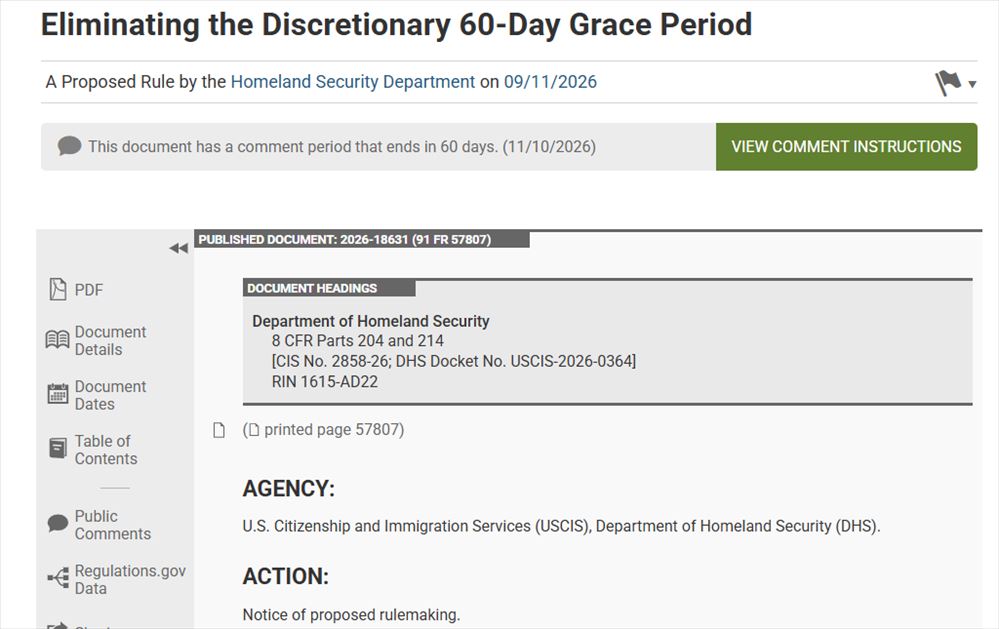
This time, it affects statuses such as E-1, E-2, E-3, H-1B, H-1B1, L-1, O-1, TN, and their dependents. According to the current proposed plan, if the employment relationship is terminated, the individuals concerned will, in principle, no longer be able to rely on their original work status to remain in the U.S., unless they already have other legal bases for staying.
I. 99.2% Concentrated in H-1B
The Impact is Most Obvious
The set of data released by DHS this time is highly noteworthy.
According to DHS estimates, about 3,795 relevant work visa holders each year will have a new employer file an I-129 petition for them within the maximum 60-day grace period.
Among them, about 3,765 belong to H-1B, accounting for 99.2%.
In other words, among the group estimated by DHS to actually utilize the 60-day window to complete the filing of an I-129 by a new employer, almost all are H-1B holders.
This also means that although the proposed rule involves multiple work visa categories, from the actual data, H-1B is undoubtedly the group where the impact is most concentrated.
II. Once the 60 Days are Cancelled
Both Work and Family Status Will Be Affected
Under current rules, eligible work visa holders such as H-1B can receive a grace period of up to 60 days after the termination of employment.
This system has been in place since 2017. One of the primary purposes of its establishment was to improve the job mobility, stability, and flexibility of highly skilled foreign workers after unemployment.
For H-1B holders, these 60 days are very practical.
After a sudden layoff by a company, they need to look for jobs, interview, and negotiate offers; the new company also needs to initiate relevant processes, prepare materials, and submit a new I-129 petition.
In the past, the 60 days provided an important status buffer.
But if this rule is ultimately implemented, this important status buffer period may cease to exist.
In addition, DHS clearly pointed out that individuals who fail to maintain nonimmigrant status may receive a Notice to Appear (NTA) in immigration court and face removal proceedings; depending on the circumstances, if unlawful presence is further accumulated, it may also trigger a 3-year or 10-year bar to re-entry.
By then, what H-1B holders face will not just be: “Can I find the next job within 60 days?”
But rather: “Before the job ends, has the new status arrangement been prepared?”
The pressure between the two is completely different.
For ordinary professionals, a company layoff first means an interruption of income; but for H-1B families, it may also simultaneously affect legal residence, spouse's status, children's lives, and the choice of the next job.
The proposed rule also involves relevant dependents. DHS also clearly analyzed that if the primary applicant's work status is affected due to the termination of employment, the status of their dependents relying on the primary applicant may also be affected consequentially.
Therefore, for those who have lived in the U.S. for many years, whose children go to school, and whose family assets and life focus have gradually shifted to the U.S., whether their status depends on a job in the long term is becoming a question that increasingly needs to be considered in advance.
III. From Relying on Employers
To Planning Long-Term Status in Advance
In recent years, from the H-1B lottery and employer hiring policies to the transition of status after layoffs, the uncertainty facing work status in the U.S. has been continuously increasing.
And the 99.2% released by DHS this time once again places a reality in front of many families:
If the plan to stay in the U.S. long-term has always relied on the H-1B, once the job changes, the status may also be affected accordingly.
For families who have clearly expressed their desire to develop in the U.S. long-term, they can also consider more independent status paths in advance.
For example, EB-5 Investor Visa does not rely on employers, does not require participation in the H-1B lottery, and once status is obtained, career choices and family arrangements will no longer change completely with a single job.
Currently, EB-5 is in a time window worth seizing.
On one hand, the three categories of reserved visas under the new EB-5 law are still in a no-backlog state; on the other hand, two important dates are approaching: September 30, 2026, marks a key milestone for the grandfathering clause; starting January 1, 2027, the minimum EB-5 investment amount is expected to rise from $800,000 to $900,000—$950,000 or even higher.
For families who already have clear plans for U.S. status, there is currently both a no-backlog window and approaching dates for policy and investment amount adjustments. Rather than waiting for the window to tighten and reacting passively, it is better to plan in advance and lock in the advantages of the current policy and investment costs as early as possible.