4 States Have Acted! US Public Universities Block Undocumented Students
US higher education is further tightening its requirements on legal status.
Recently, the Board of Governors of the State University System of Florida officially passed a new regulation: starting from the 2027—2028 academic year, students "undocumented" in the US will face restrictions on first-time enrollment at Florida public universities. The new rule affects 12 public universities under the State University System of Florida.
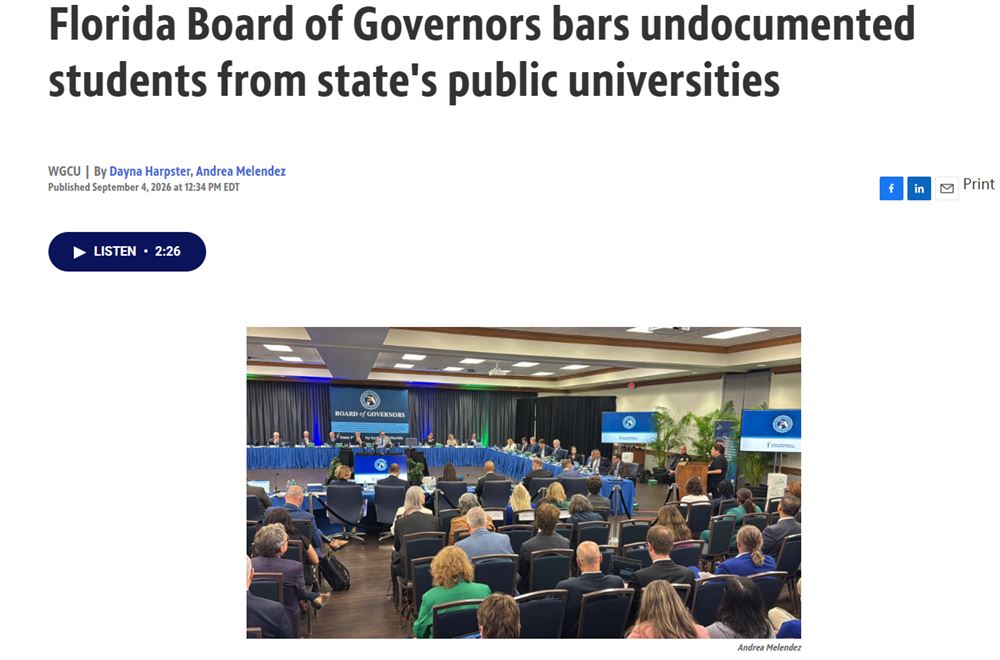
Worldway Immigration notes that this change serves as another reminder to families planning US education: besides schools, majors, and grades, legal status can also affect children's future education and development choices.
I. Florida Further Tightens
Enrollment of Undocumented Students
The new regulation affects 12 public universities under the State University System of Florida, including the University of Florida (UF), Florida State University (FSU), Florida International University (FIU), University of Central Florida (UCF), University of South Florida (USF), etc.
According to the regulation, starting from the 2027—2028 academic year, if a state university has not admitted all academically qualified applicants in the past two academic years, the school will not be allowed to enroll students who are undocumented in the US.
For highly competitive schools like UF and FSU, which reject a large number of qualified applicants every year, this regulation practically means that it will be very difficult for undocumented students to enter these Florida public universities in the future.
Moreover, this tightening is not an isolated event.
In June this year, the Florida State Board of Education passed relevant regulations to tighten enrollment requirements for its 28 public colleges, restricting the enrollment of undocumented students, which also affects GED and adult education courses.
Looking across the United States, Florida is not the first.
Prior to this, three states had already implemented varying degrees of relevant restrictions:
· Alabama: Prohibits undocumented students from entering public higher education institutions;
· South Carolina: Prohibits undocumented students from entering public higher education institutions;
· Georgia: Restricts undocumented students from entering certain competitive public universities.
With Florida joining, there are now four states that have placed varying degrees of restrictions on undocumented students entering public universities, and Florida is the most populous state among them.
From these changes, it is also evident that when receiving education in the US, "legal status" is becoming a long-term factor that can increasingly not be ignored.
II. Children's Development in the US
The Hurdle of Legal Status Cannot Be Avoided
When many families initially consider US education, they often focus on schools and majors.
But after the children actually go to the US, a longer-term question will also arise: After graduating from college, under what status will they continue to stay in the US?
The F-1 student visa can solve the problems during the study abroad phase, but in essence, it is still a non-immigrant status. After graduation, if they wish to continue developing in the US, they still have to face stages such as OPT, work visas, and subsequent status conversion.
A policy change in any of these stages could affect the child's next choices.
In contrast, if the family secures a more stable long-term status in advance, the child's future choices in schools, majors, employment, and living arrangements will be much more relaxed.
The true value brought by legal status is not just solving the question of "whether they can stay", but allowing children to have more choices at important milestones in their lives.
For families who have already made it clear that they want their children to study and work in the US, or even for the whole family to develop in the US long-term, education planning and immigration status planning should actually be considered together.
III. Planning Legal Status in Advance
The EB-5 Window Is Still Open
Precisely because of this, more and more families are also starting to pay attention to EB-5 investment immigration simultaneously when planning US education.
According to current policies, qualified EB-5 investors can apply for US permanent resident status together with their spouses and eligible unmarried children under the age of 21.
For families wishing to develop in the US long-term, EB-5 solves not just the child's study status at a certain stage, but the long-term status arrangement for the entire family.
Currently, under the new law, the minimum EB-5 investment remains $800,000. Meanwhile, according to the latest visa bulletin, the three reserved visa categories for EB-5 (rural, high unemployment areas, and infrastructure) all show "C" for applicants born in mainland China, meaning there is currently no backlog (no visa queue), with the rural category also enjoying priority processing.
However, the current policy window is also approaching a new milestone.
According to current law, starting from January 1, 2027, the minimum EB-5 investment amount will be raised to $900,000–$950,000 or even higher. At the same time, September 30, 2026, is also an important milestone for the grandfathering clause of the EB-5 Regional Center Program.
For families who have already decided to plan their US status through EB-5, project selection, financial arrangements, and application materials all need to be prepared in advance.