Why Was the New US D/S Rule Urgently Halted on the Eve of Taking Effect?
The new US international student status rule, originally scheduled to take official effect on September 15, 2026, was halted by a court the day before it was to take effect.
Worldway Immigration noted that, on September 14, local time, Judge F. Dennis Saylor of the US District Court for the District of Massachusetts issued an order blocking the US Department of Homeland Security (DHS) from implementing the new rule regarding fixed periods of stay for F, J, and I nonimmigrants as originally planned.
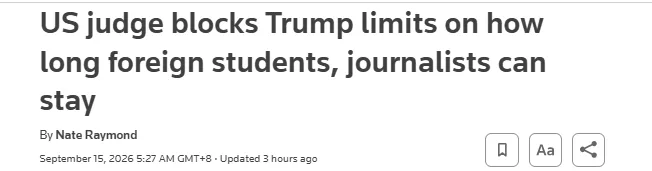
This means that, the planned “elimination of D/S and transition to a fixed period of stay” scheduled to take effect on September 15 will temporarily not be implemented, and the current D/S system will continue to be maintained.
1. D/S System Temporarily Maintained
What Was the New Rule Originally Intended to Change?
In July of this year, DHS officially published the final rule, planning to change the long-standing Duration of Status (D/S) system used by F, J, and I nonimmigrants. DHS announced at the time that the rule was scheduled to take effect on September 15, 2026.
Under the current system, qualifying F-1 students can generally remain in the US for the duration of their studies and lawful status, with their I-94 typically marked as “D/S” rather than a specific status expiration date.
The new rule originally planned to change this model to a fixed period of stay.
Among them, the authorized period of stay for F international students and J exchange visitors would, in principle, not exceed a maximum of 4 years; for I foreign media representatives, it would generally be a maximum of 240 days. Those needing to remain in the US would likely need to apply for an extension in accordance with regulations.
In other words, once implemented, international students will face more explicit time limits for their future studies, extensions, and status transitions in the US.
Now, with the court's intervention, this new rule will temporarily not be implemented as originally planned.
2. Why Was It Halted
the Day Before Taking Effect?
This case was initiated by organizations related to international education and higher education.
Judge F. Dennis Saylor believed that in pushing for this major institutional change, DHS did not adequately explain why the long-standing D/S system had to be changed, nor did it fully consider less restrictive alternatives.
The court also believed that the new rule could have a significant impact on US universities, international students, and the higher education system as a whole.
Therefore, the court ultimately ordered a stay on the implementation of the new rule.
However, it should be noted that this does not mean the new rule has been permanently canceled. Currently, the court has adopted a temporary stay, and related litigation may continue. Whether the US government will appeal in the future and whether the new rule will enter the implementation process again remain to be seen. Worldway will continue to monitor the situation closely.
3. Temporary Buffer Obtained
Status Planning Still Cannot Be Relaxed
This ruling provides a certain policy buffer for families who are already studying in the US, planning to apply for OPT, or preparing to study in the US.
At this stage, F-1 and J-1 status holders can continue to maintain their lawful status under current rules, and should promptly pay attention to subsequent official notices from their school's international student office, as well as USCIS and DHS.
But the temporary stay of the policy does not mean that uncertainty has disappeared.
Looking at the series of changes in US study, work visas, and lawful status management since this year, an increasingly obvious trend is: the US scrutiny and management of nonimmigrant status are becoming stricter, and the frequency of policy changes is also increasing.
Therefore, whether currently studying in the US or planning to remain in the US through OPT or H-1B in the future, in addition to the school and major, the status timeline also needs to be planned in advance.
4. From Study Planning
To Long-Term Status Planning
If a family has clearly decided that they want their child to continue working and living in the US after graduation, or even for the entire family to develop in the US long-term, then what needs to be considered is not just short-term changes in a particular student or work visa policy, but whether the entire status pathway is stable enough.
F-1, OPT, and H-1B are essentially nonimmigrant status arrangements at different stages; if the family itself has long-term plans to remain in the US, they can also evaluate immigration pathways such as EB-5 in advance.
Unlike relying on schools, employers, and the continuation of nonimmigrant status, EB-5 aims to obtain US permanent resident status. For qualifying investors, their spouses and unmarried children under the age of 21 can also apply together.
From the perspective of the current policy window, on one hand, the three categories of reserved visas under the new EB-5 law are currently still in a "no backlog" status; on the other hand, two important time nodes are also approaching: September 30, 2026, marks a key node for the grandfathering clause; starting January 1, 2027, the minimum EB-5 investment amount is expected to be raised from $800,000 to $900,000—$950,000 or even higher.
For families who have already decided to plan their long-term US status through EB-5, the time left for project selection, fund arrangement, and application material preparation is becoming increasingly limited.