A Major Reshuffle for Staying in the US! Even Tech Giants Can't Guarantee Your Sponsorship
If a child has excellent academic performance, majors in popular fields like artificial intelligence or computer science, and receives an offer from a well-known U.S. tech company upon graduation, does it mean they can smoothly work in the U.S. and have the opportunity to settle down long-term in the future?
For many families of international students, this used to be an ideal planning route: choose a good major, enter a prestigious school, find a good job, and then gradually resolve the status issue. But reality may be more complex than imagined.
On October 26, 2026, local time, AI company Anthropic submitted an S-1 registration statement to the U.S. Securities and Exchange Commission (SEC) in preparation for an initial public offering (IPO). In the risk factors section of the filing, the company explicitly pointed out:
Changes in immigration policies that restrict the mobility of professional and technical talent could hinder the company's ability to recruit and retain highly qualified employees, and adversely affect its business and operating performance.
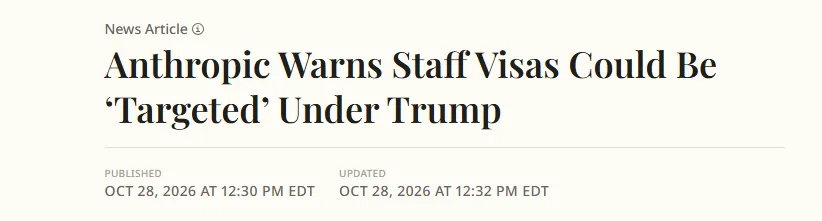
Even AI companies in dire need of top talent list immigration policy as an operational risk. This also brings a noteworthy question to light: in the United States, does having an ideal job mean you can stably stay? Worldway Immigration believes that there are still many factors to consider between job opportunities and long-term status security.
PART 01: Companies Need Talent, So Why Are They Still Worried About Not Being Able to Retain Them?
Anthropic mentioned in its listing documents that talent is one of the company's key competitive advantages. To maintain this advantage, the company needs to continuously recruit outstanding researchers and engineers while retaining existing highly qualified employees.
However, changes in immigration policies may restrict the mobility of professional talent, affecting the company's recruitment and talent retention capabilities.
This reveals an easily overlooked reality: whether a company is willing to hire you and whether you can smoothly obtain work authorization and maintain your working status in the U.S. long-term are two different issues.
For international students, an ideal offer means their personal abilities have been recognized by the company. However, to actually start working, they still need to meet the corresponding work authorization and status requirements.
For employers, even if they highly favor a candidate, they cannot unilaterally decide the approval outcome of an immigration application, let alone guarantee that future policies will remain unchanged.
When issues arise with visa applications, work authorization, or status transitions, the impact may extend beyond the individual employee to include the company's recruitment schedules, project progress, and talent development plans.
PART 02: H-1B Work Visa, Are Status Risks Increasing?
H-1B is an important work visa category for U.S. companies to employ qualified foreign professional talent, and it is also a common pathway for many international students to work in the U.S. after graduation.
However, H-1B is not a permanent resident status; its application, maintenance, and subsequent transition are all subject to corresponding regulations and approval requirements. Recently, policy changes in the U.S. surrounding work visas and employment relationships have also brought more uncertainty for international talent and employers.
1. Work Visas Are Closely Related to Employment Relationships
H-1B is typically tied to the petitioning employer and the approved work arrangement. If an employee resigns, is laid off, or changes employers, they need to promptly assess how their subsequent status will transition.
Current U.S. rules allow certain qualified non-immigrant work visa holders to receive a grace period of up to 60 days after employment termination. The U.S. Department of Homeland Security previously proposed a rule planning to eliminate the relevant grace period arrangements.
2. Policy Changes May Also Affect Corporate Recruitment
The U.S. government continues to introduce or discuss adjustments regarding H-1B application fees, employer compliance, and audit requirements.
These changes may increase the cost for companies to hire international talent, and may also affect arrangements for employee transfers, renewals, and long-term sponsorship.
For tech companies that highly rely on international talent, how to continuously attract and retain outstanding employees under policy uncertainty has become a practical issue that needs to be considered.
3. Obtaining a Work Visa Does Not Equal Long-Term Status Security
For international talent hoping to stay in the U.S. long-term, obtaining a work visa for the first time is just one stage. Subsequent renewals, changes of employers, and employment-based immigration applications may all involve different conditions and review requirements.
PART 03: Beyond Work Visas, How to Plan for Long-Term Status?
An offer from a well-known tech company can open the door to career development, but it cannot decide for a person whether they can smoothly stay in the U.S. over the next few years.
This is precisely the revelation that Anthropic's risk warning brings to international student families: professional competitiveness can be strived for by oneself, but status arrangements are still affected by factors such as policies, application conditions, and approval progress.
If a family's goal is not just for their child to find a good job, but also to develop long-term in the U.S., then besides employer sponsorship, they can also explore other status planning pathways.
For families with corresponding investment capabilities, the EB-5 investment immigration is one such option. It does not require the applicant's continuous employment with a specific company as a basic prerequisite for obtaining U.S. permanent resident status, providing a planning direction for long-term development in the U.S. that differs from work visas.
In addition, qualified applicants in the U.S., when visa numbers are available and adjustment of status requirements are met, can concurrently file the I-526E investment immigration petition and the I-485 adjustment of status application, and apply for employment authorization (EAD) and advance parole (AP) according to regulations, securing more flexibility for work and travel arrangements.
PART 04: Don't Let Status Planning Become the Final Hurdle in Career Development
Choosing a major, attending a prestigious school, doing internships, and getting offers—children invest a significant amount of time and effort into their career development. However, if they only start considering status issues when onboarding, transferring, or renewing visas, they may have already missed the window for a more relaxed planning process.
A truly comprehensive plan for staying in the U.S. is not just about helping children secure opportunities to enter good companies, but also about considering in advance how to make those opportunities go further.
It is recommended that families with plans for studying in the U.S., graduation employment, and long-term residence incorporate status issues into their overall arrangements in advance, understand different pathways based on their own conditions, and retain more initiative for the future.