White House Leadership Change: US Immigration Winds are Shifting!
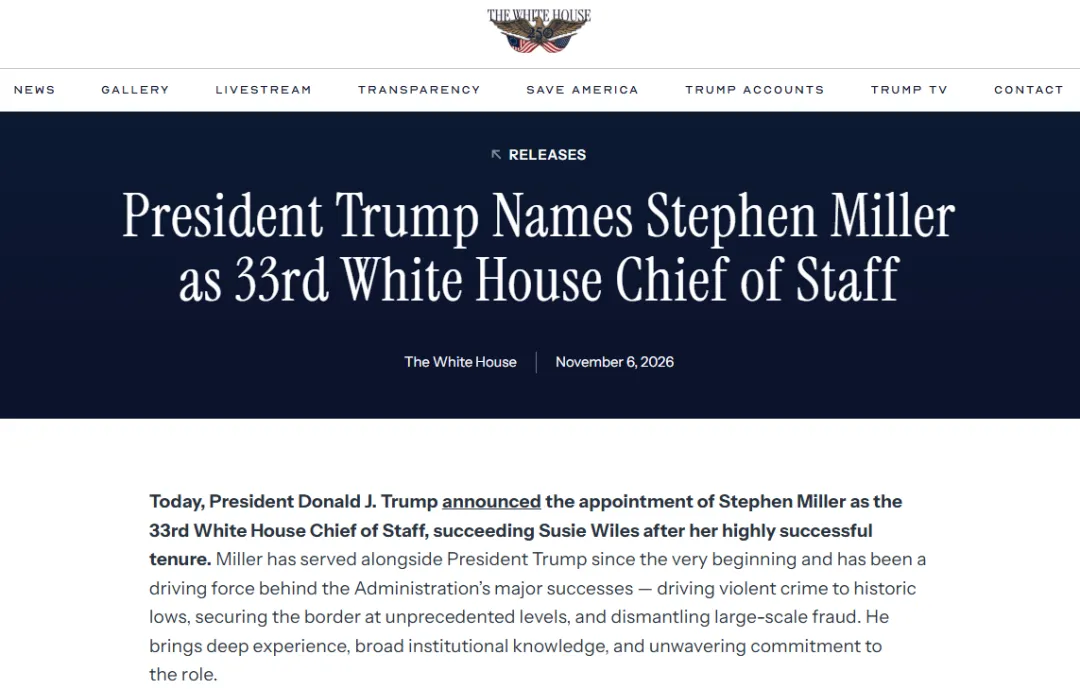
On November 6, 2026, local time, the White House announced that Donald Trump appointed Stephen Miller as the 33rd White House Chief of Staff, effective on the 9th. The announcement had little embellishment, repeatedly emphasizing one sentence—Miller is the most steadfast and long-serving promoter of the "America First Agenda".
Many people's first reaction might be: just another executive taking office. But for international students in the US, H-1B holders, and families waiting in line for green cards, the weight of this personnel news is far from ordinary.
1. Why the Change of the "Gatekeeper" Matters to Families Planning to Stay in the US
The White House Chief of Staff is not a ceremonial role. He decides which issues reach the President's desk and in what order they are pushed forward, while coordinating implementation across departments. While the policy direction is set by the President, the intensity and pace of the policies are often determined by the Chief of Staff.
Miller joined Trump's campaign team in 2016 and was a key architect of the Trump administration's hardline immigration stance. He pushed for the "zero tolerance" family separation policy and travel bans during the first term. After returning to the White House in 2025 as Deputy Chief of Staff and Homeland Security Advisor, he publicly proposed a goal of "arresting 3,000 people a day" and pushed to crack down on "birth tourism" and challenge birthright citizenship. A White House observer described him as having "only one mode: pedal to the metal."
2. More Critical Than the Choice of Person is the Timing
The appointment comes after the midterm elections. With the Democrats taking control of both the House and the Senate, the legislative path through Congress will be difficult, making executive orders the main battlefield. Miller previously co-led a months-long review specifically to identify measures that "can be implemented without congressional approval."
From this, three trends can be deduced:
① Faster —— Rules will suddenly land in the form of proclamations, memorandums, and proposed rules;
② More Detailed —— Scrutiny will drill down to social media, employer qualifications, and school programs;
③ Harder to Reverse —— Driven by executive orders, stopping them often requires lawsuits, which themselves take years.
3. What Has Already Happened Over the Past Year or So
September 2025, an additional $100,000 fee for new H-1B applications: Ruled illegal by a federal judge in June 2026, the government appealed, and in August proposed a fee of approximately $103,000.
H-1B changed from a random lottery to "weighted selection", favoring high-paying positions, effective February 27, 2026.
August 2026, proposal to eliminate the 60-day grace period after unemployment—after being laid off, there may not be enough time to find a job.
October 2026, 9 universities investigated over J-1 visas; proposed fee of $70,000 for international students' initial OPT application, plus an additional $30,000 for extensions.
May 2026, USCIS adjusted the green card process: immigrant visas processed at embassies and consulates abroad will be the standard route; eligible applicants can still file I-485 domestically, with approval decided on a case-by-case basis.
October 2026, PERM processing suspended for Microsoft and several other companies, with PERM being the first step for employment-based green cards;
October 2026, the proposed rule for PERM labor certification reform completed White House review, aiming to adjust recruitment testing in the US labor market and strengthen protections for US workers.
Connecting the dots, the main line is clear: Staying in the US is shifting from "waiting in line by process" to "grabbing a spot by window."
4. Three Types of Families, Three Types of Risks
▍Currently Studying or Recently Graduated
OPT→H-1B→PERM→Green Card: every single step is seeing price hikes, increased scrutiny, and added uncertainty. Don't just calculate tuition; calculate the total time required for status.
▍Already Holding H-1B
Your employer is not just a paycheck, but also your status sponsor. Layoffs and PERM suspensions could wipe out years of accumulation in an instant.
▍Going Through PERM to Queue for Green Card
Waiting in line isn't the scary part; what's scary is the rules changing midway. While you are waiting in line, the rules might change, thresholds might rise, or the window might even close.
5. Why EB-5 Deserves a Separate Discussion
Let's be clear: EB-5 is not a shortcut, but a different logic—it does not tie you to an employer, does not rely on a lottery, and uses verifiable investment to exchange for a relatively independent path to status. EB-5 is established based on federal legislation and supported by a statutory framework, making it much more stable compared to many immigration channels driven by executive orders.
Among them, the reserved category projects are very friendly to eligible families: when the investor has legal status in the US and visas are available, they can concurrently file I-526E and I-485, obtaining an employment authorization document (EAD) and advance parole (AP) during the waiting period to legally reside, work, and travel in and out of the country.
⚠️ But the window of opportunity also has a clear time limit:
Starting January 1, 2027, the minimum EB-5 investment amount will be adjusted for inflation by law, with Target Employment Area (TEA) projects expected to rise from $800,000 to over $900,000. According to the rules, locking in the current threshold is based on the formal acceptance of the application by USCIS—tracing the source of funds, project evaluation, and document preparation all require corresponding lead time.
6. Conclusion · Seize the Initiative While the Rules Are Still Clear
Policy cycles have their ups and downs, but the window of opportunity for status planning waits for no one. Miller's appointment is just the latest example, but not necessarily the last. Rather than passively waiting for rules to change, it is better to evaluate early, file early, and lock in your priority date as early as possible while the rules are still clear. This is both a certain way to deal with uncertainty and a practical challenge left for every family planning to stay in the US.