Nobel Prizes and American Immigration: Why the U.S. is a Global Talent Hub?
Recently, an article published in Nature magazine, "How Immigrants Are Reshaping the Nobel Landscape," revealed a surprising fact:
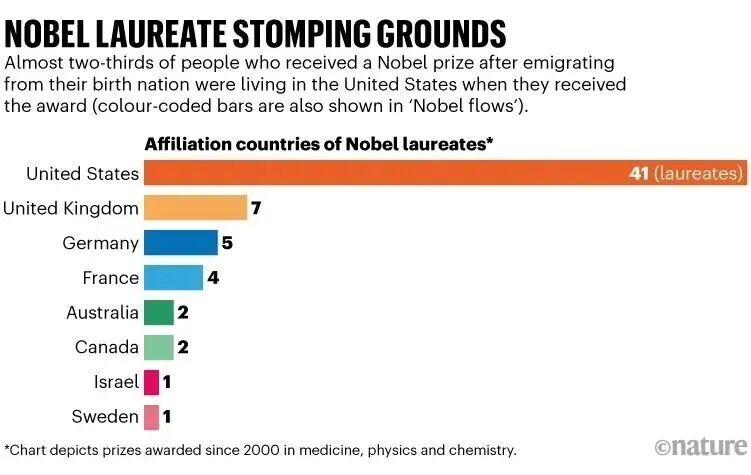
00Since the 21st century, of the 202 scientists who have won Nobel Prizes in science, over 30% are "transnational researchers" who completed their research in foreign countries and received the highest honors. Among them, 41 immigrant scientists ultimately chose to complete their major research achievements in the United States.
00The Migration of Science:
00A True Reflection of Cross-Border Research
00This year's Nobel Prize once again confirms a fact—science knows no borders, and talent is on the move.
00Among the three winners of the Chemistry Prize, two are "transnational researchers":
00• Richard Robson, born in the UK and now residing in Australia;
00• Omar Yaghi, born in Jordan and now a professor at the University of California, USA, who is also the first Jordanian-born Nobel Chemistry Prize winner in history.
00(Yaghi's experience is itself a reflection of "immigration changing destiny." Born in 1965 in Amman, Jordan, to a Palestinian refugee family, he went to the U.S. at 15 as a refugee, started at a community college, and through hard work, entered the State University of New York and earned a Ph.D. Today, he is a professor at the University of California, Berkeley, and a member of the U.S. National Academy of Sciences—a journey from refugee to Nobel laureate, exemplifying the "migration of science.")
00Among the three winners of the Physics Prize, two are also immigrants:
0000• Michel H. Devoret, born in France
0000• John Clarke, born in the UK.
0000Both have been engaged in long-term research and teaching in the United States.
0000These examples show that the birth of scientific achievements often transcends national borders. The migration of scientists is not just a personal choice but an inevitable result of the reorganization of the global research landscape.
0000In fact, immigrant scientists have long been a part of Nobel Prize history.
0000Einstein moved from Germany to Switzerland, then to the United States;
0000Madame Curie left Poland to establish a laboratory in France.
0000As Ina Ganguli, an economist at the University of Massachusetts, said:
0000"Genius can be born anywhere, but opportunities are not."
00002010 Nobel Physics Prize winner Andre K. Geim also remarked:
0000"If you stay in one place all your life, you miss half the opportunities. Mobility benefits everyone."

0000America: The Ultimate Destination for Research Talent
0000This "flow of science" continues globally, and the United States is undoubtedly the ultimate gathering point. Data shows that since the 21st century, 41 of the 63 "immigrant Nobel laureates" have settled in the United States.
0000The reason the United States has become the ultimate destination for research talent is due to its strong research ecosystem and comprehensive institutional support: ample research funding; concentrated high-quality educational resources; and well-established identity pathways such as H-1B, J-1, EB-1, and NIW. These allow scientists to pursue academic freedom and achieve long-term residency.
0000New Turning Point:
0000From Visa Retention to Investment Retention
0000However, with international situations and policy adjustments, the traditional "research channel" is becoming increasingly crowded.
0000H-1B quotas are scarce, F-1 student visa restrictions are tightening, and approval cycles are lengthening... Research talent in the U.S. must race against time and navigate identity challenges.
0000Thus, another more direct and stable channel is gaining attention—the EB-5 investment immigration program. Unlike work or academic visas dependent on employers, EB-5 allows applicants to obtain U.S. residency by investing to create jobs.
0000Since the implementation of the "Reform and Integrity Act" in 2022, EB-5 has seen three key innovations:
0000• Ample reserved visa quotas, enjoying exemption from waiting periods
0000• Rural EB-5 projects, enjoying priority review
0000• Allowing "dual filing" applications, simultaneously submitting I-526E and I-485 applications, obtaining a Combo Card in about 3 months for legal residency and work.
0000Science knows no borders, but opportunities have direction
0000Behind the Nobel Prize is a history of knowledge flow and a reflection of institutional competition. As research, capital, ideals, and identities flow globally, the United States remains the land where talent takes root and dreams shine. Whether you are a research talent, entrepreneur, or a family planning for the future, choosing the right path means choosing a bigger stage.
0000EB-5 U.S. Investment Immigration—giving wings to your dreams, allowing you and your family to root in the center of opportunity.
0000Additionally, the world's first launch by Worldway Group, in collaboration with two top U.S. law firms, proudly presents the "Trump Gold Card Immigration Project," providing a new identity planning pathway for high-net-worth individuals. Worldway has opened the Trump "Gold Card Immigration" project presale channel. Register now, submit early, and be a step ahead to obtain a U.S. green card in the future.